
YQ8563: Drop-In Low-Power RTC Replacement for NXP PCF8563
Time: 2026-10-19 11:10:26
Every RTC socket designed around the NXP PCF8563 eventually meets the same three questions: what happens when lead times stretch, when allocation tightens, and when a single supplier becomes a single point of failure? The YQ8563 answers all three. It is a CMOS real-time clock / calendar developed as a domestic alternative to the PCF8563 — pin- and register-compatible, I²C-based, and specified at 0.25µA backup current so that a coin cell or lithium battery keeps time for years, not months. For a design team that wants a second source without a PCB respin, it is the shortest route from a locked BOM to a flexible one.
This guide covers what the YQ8563 is, what stays identical when you swap it in, what you gain, and how to qualify it. If you are still comparing the wider timing portfolio, start from the RTC category and work down from there.
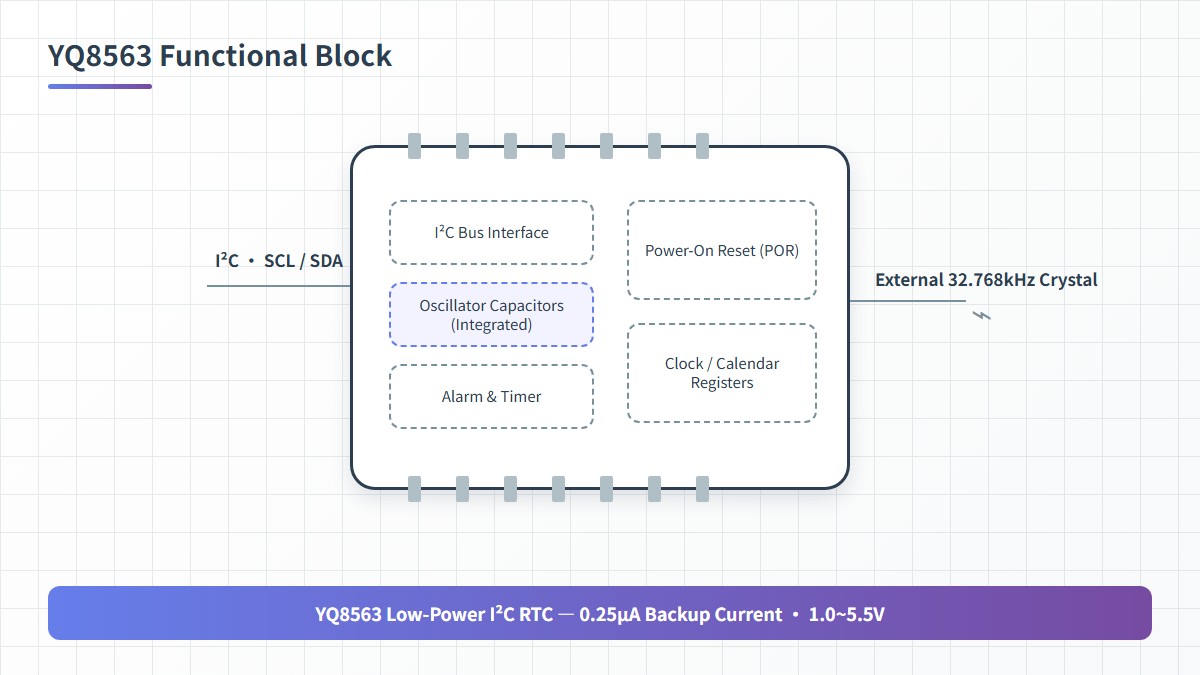
Figure 1: YQ8563 functional block — I²C interface, external 32.768kHz crystal, alarm and timer, integrated oscillator capacitors and internal power-on reset (POR).
1. YQ8563 at a Glance
| Parameter | YQ8563 |
|---|---|
| Function | CMOS real-time clock / calendar |
| Reference part | Pin- and register-compatible with NXP PCF8563 |
| Bus interface | I²C |
| Time base | External 32.768kHz crystal |
| Backup current | 0.25µA |
| Supply voltage | 1.0~5.5V — timekeeping maintained down to 1V |
| On-chip functions | Alarm and timer, integrated oscillator capacitors, internal power-on reset (POR) |
| Packages | MSOP8 / SOP8 |
| Package size | 3.0×3.0×0.85 mm or 3.9×4.9×1.4 mm |
| Operating temperature | -40~+85°C |
Architecturally the YQ8563 sits in the classic low-power I²C RTC class: an I²C-bus interface, a 32.768kHz time base and a register bank your firmware already knows how to talk to. You can see the same family grouping in our I²C-bus interface low-power RTC section.
2. What Stays the Same: the PCF8563 Compatibility Checklist
The value of a drop-in alternative is measured in what you do not have to change. The table below is the qualification checklist we walk through with customers before a first sample build.
| Design item | What YQ8563 delivers | Migration impact |
|---|---|---|
| Pinout & footprint | Pin-compatible with NXP PCF8563 in MSOP8 / SOP8 | No PCB redesign |
| Register set | Basically compatible with the PCF8563 register map | Existing driver code is reusable |
| Bus | I²C | No bus or level-shift rework |
| Time base | External 32.768kHz crystal | Keep the crystal already on the board |
| Oscillator capacitors | Integrated on-chip | Fewer external passive components |
| Power-up behaviour | Internal power-on reset (POR) | Predictable, repeatable start-up |
| Interrupt functions | Alarm and timer | Scheduled wake-up and event timing preserved |
3. Four Gains You Get From the Swap
- 0.25µA backup current: In battery-backed designs the RTC is the one block that never sleeps. At 0.25µA the YQ8563 removes itself from the battery-life conversation — a decisive advantage in always-on IoT nodes, metering and portable instruments where the backup cell is expected to outlive the product's service interval.
- 1.0~5.5V wide supply, timekeeping down to 1V: One part covers 1.8V, 3.0V, 3.3V and 5V logic rails, and keeps counting even when the backup rail sags to 1V. That is exactly the behaviour lithium and coin-cell systems need: no brown-out amnesia when the main supply collapses.
- Integrated oscillator capacitors and internal POR: The load capacitors that usually sit next to a 32.768kHz crystal are integrated, and an internal power-on reset guarantees a defined start state. Both changes reduce BOM line count and remove two classic sources of assembly and bring-up faults.
- Real RTC functionality, industrial temperature: Alarm and timer functions cover scheduled wake-up, periodic logging and event stamping without a host CPU babysitting the clock, while the -40~+85°C range and MSOP8 / SOP8 packages keep the part usable from wearables to white goods and outdoor metering hardware. More wide-temperature, low-power options are listed in our low-power portfolio.
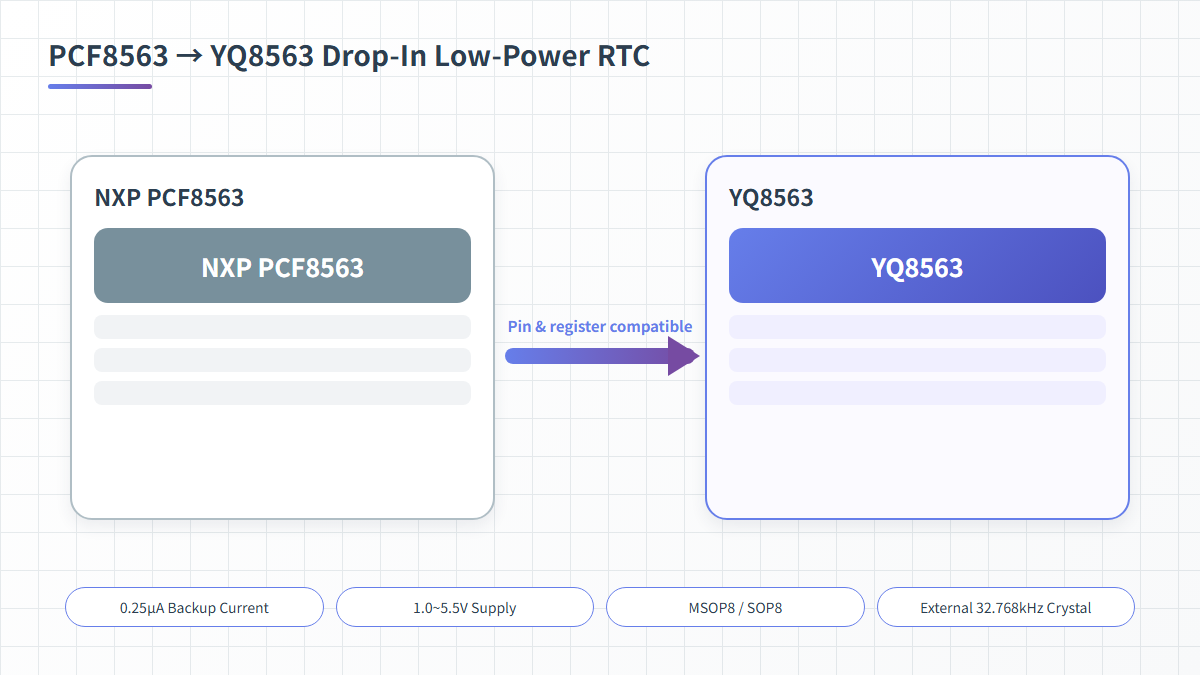
Figure 2: PCF8563 to YQ8563 — same footprint and register behaviour, with 0.25µA backup current and a 1.0~5.5V supply window.
4. Migration Guide: Five Steps to a Qualified Swap
- Confirm the package: match your existing footprint against MSOP8 (3.0×3.0×0.85 mm) or SOP8 (3.9×4.9×1.4 mm) before releasing a test build.
- Keep the 32.768kHz crystal: the YQ8563 uses an external crystal, so your existing time base stays. With oscillator capacitors integrated, review whether the external load capacitors in your current design are still required.
- Reuse the firmware: the I²C bus and the basically compatible register set mean your read/write routines, time-keeping structures and BCD conversions normally port across unchanged.
- Re-verify the interrupts: exercise the alarm and timer paths under your own application timing, and confirm the internal POR produces the start-up state your initialisation sequence expects.
- Validate the backup rail: run a supply-collapse test down to 1V and confirm that timekeeping continues and the calendar data survives. Then order samples of the YQ8563 and qualify on your own board.
5. Where the YQ8563 Fits
- IoT & consumer electronics — the largest application cluster: sensor nodes, wearables, gateways and battery-powered devices where 1V timekeeping and 0.25µA backup current translate directly into shelf life and battery life.
- Smart metering — electricity, water and gas meters that must timestamp consumption accurately for years on a backup cell.
- Industrial and portable instruments — data loggers, handheld test equipment and field devices that operate across the full -40~+85°C range.
- White goods and small appliances — ovens, washing machines, timers and control panels that need a low-cost clock with a defined power-up state.
Across all four clusters, YQM ELECTRONICS supplies the YQ8563 alongside the rest of the real-time clock range and the full component catalogue, with FAE support from first sample to volume ramp.
6. YQ8563 or YQ8025T? External Crystal vs Integrated DTCXO
Both parts keep time. The difference is where the time base lives. The YQ8563 relies on an external 32.768kHz crystal; the YQ8025T takes the opposite approach and integrates a DTCXO inside the package.
| Item | YQ8563 | YQ8025T |
|---|---|---|
| Time base | External 32.768kHz crystal | Built-in DTCXO (digital temperature-compensated crystal oscillator) |
| Parts around the RTC | Crystal on the board | No external crystal required |
| Best fit | Pin- and register-compatible replacement of PCF8563-based designs; maximum BOM flexibility | Designs that want a self-contained, temperature-compensated time base on the board |
Rule of thumb: if the socket was designed for a PCF8563 and the crystal is already there, choose the YQ8563. If you are designing a new board and would rather not carry a discrete time base at all, evaluate the YQ8025T first.
7. FAQ
Q: Is the YQ8563 pin-compatible with the NXP PCF8563?
A: Yes. The YQ8563 is designed as a domestic alternative to the NXP PCF8563 with basic pin and register compatibility, so in most designs it drops into the same MSOP8 or SOP8 footprint and reuses existing firmware.
Q: Does the YQ8563 need an external crystal?
A: Yes — it uses an external 32.768kHz crystal as its time base. The oscillator load capacitors are integrated on-chip, which reduces the number of external components around the RTC.
Q: How low can the supply voltage go?
A: The YQ8563 operates from 1.0~5.5V and maintains timekeeping down to 1V, which makes it suitable for lithium and coin-cell backup architectures where the backup rail drops well below the main supply.
Q: What is the backup current?
A: 0.25µA. That is the current drawn in backup operation, and it is the number that decides how long a coin cell can keep the calendar alive.
Q: What functions are integrated besides timekeeping?
A: Alarm and timer functions, integrated oscillator capacitors, and an internal power-on reset (POR) that provides a defined start-up state.
Q: In which applications is the YQ8563 most commonly designed in?
A: IoT and consumer electronics above all, followed by smart electricity, water and gas metering, industrial and portable instruments, and white goods / small appliances.
The takeaway: if your BOM still names a PCF8563, the YQ8563 gives you the same socket, the same bus and the same register behaviour — at 0.25µA, across 1.0~5.5V, in an industrial temperature range. Order the YQ8563 sample, or talk to our FAE team about a compatibility check against your current schematic and driver.
Qualify the YQ8563 on Your Own Board
●0.25µA Backup Current
●1.0~5.5V Wide Supply
●PCF8563 Pin & Register Compatible
●FAE Migration Support
YQ8563: Drop-In Low-Power RTC Replacement for NXP PCF8563
Time: 2026-10-19 11:10:26
Every RTC socket designed around the NXP PCF8563 eventually meets the same three questions: what happens when lead times stretch, when allocation tightens, and when a single supplier becomes a single point of failure? The YQ8563 answers all three. It is a CMOS real-time clock / calendar developed as a domestic alternative to the PCF8563 — pin- and register-compatible, I²C-based, and specified at 0.25µA backup current so that a coin cell or lithium battery keeps time for years, not months. For a design team that wants a second source without a PCB respin, it is the shortest route from a locked BOM to a flexible one.
This guide covers what the YQ8563 is, what stays identical when you swap it in, what you gain, and how to qualify it. If you are still comparing the wider timing portfolio, start from the RTC category and work down from there.
Figure 1: YQ8563 functional block — I²C interface, external 32.768kHz crystal, alarm and timer, integrated oscillator capacitors and internal power-on reset (POR).
1. YQ8563 at a Glance
| Parameter | YQ8563 |
|---|---|
| Function | CMOS real-time clock / calendar |
| Reference part | Pin- and register-compatible with NXP PCF8563 |
| Bus interface | I²C |
| Time base | External 32.768kHz crystal |
| Backup current | 0.25µA |
| Supply voltage | 1.0~5.5V — timekeeping maintained down to 1V |
| On-chip functions | Alarm and timer, integrated oscillator capacitors, internal power-on reset (POR) |
| Packages | MSOP8 / SOP8 |
| Package size | 3.0×3.0×0.85 mm or 3.9×4.9×1.4 mm |
| Operating temperature | -40~+85°C |
Architecturally the YQ8563 sits in the classic low-power I²C RTC class: an I²C-bus interface, a 32.768kHz time base and a register bank your firmware already knows how to talk to. You can see the same family grouping in our I²C-bus interface low-power RTC section.
2. What Stays the Same: the PCF8563 Compatibility Checklist
The value of a drop-in alternative is measured in what you do not have to change. The table below is the qualification checklist we walk through with customers before a first sample build.
| Design item | What YQ8563 delivers | Migration impact |
|---|---|---|
| Pinout & footprint | Pin-compatible with NXP PCF8563 in MSOP8 / SOP8 | No PCB redesign |
| Register set | Basically compatible with the PCF8563 register map | Existing driver code is reusable |
| Bus | I²C | No bus or level-shift rework |
| Time base | External 32.768kHz crystal | Keep the crystal already on the board |
| Oscillator capacitors | Integrated on-chip | Fewer external passive components |
| Power-up behaviour | Internal power-on reset (POR) | Predictable, repeatable start-up |
| Interrupt functions | Alarm and timer | Scheduled wake-up and event timing preserved |
3. Four Gains You Get From the Swap
- 0.25µA backup current: In battery-backed designs the RTC is the one block that never sleeps. At 0.25µA the YQ8563 removes itself from the battery-life conversation — a decisive advantage in always-on IoT nodes, metering and portable instruments where the backup cell is expected to outlive the product's service interval.
- 1.0~5.5V wide supply, timekeeping down to 1V: One part covers 1.8V, 3.0V, 3.3V and 5V logic rails, and keeps counting even when the backup rail sags to 1V. That is exactly the behaviour lithium and coin-cell systems need: no brown-out amnesia when the main supply collapses.
- Integrated oscillator capacitors and internal POR: The load capacitors that usually sit next to a 32.768kHz crystal are integrated, and an internal power-on reset guarantees a defined start state. Both changes reduce BOM line count and remove two classic sources of assembly and bring-up faults.
- Real RTC functionality, industrial temperature: Alarm and timer functions cover scheduled wake-up, periodic logging and event stamping without a host CPU babysitting the clock, while the -40~+85°C range and MSOP8 / SOP8 packages keep the part usable from wearables to white goods and outdoor metering hardware. More wide-temperature, low-power options are listed in our low-power portfolio.
Figure 2: PCF8563 to YQ8563 — same footprint and register behaviour, with 0.25µA backup current and a 1.0~5.5V supply window.
4. Migration Guide: Five Steps to a Qualified Swap
- Confirm the package: match your existing footprint against MSOP8 (3.0×3.0×0.85 mm) or SOP8 (3.9×4.9×1.4 mm) before releasing a test build.
- Keep the 32.768kHz crystal: the YQ8563 uses an external crystal, so your existing time base stays. With oscillator capacitors integrated, review whether the external load capacitors in your current design are still required.
- Reuse the firmware: the I²C bus and the basically compatible register set mean your read/write routines, time-keeping structures and BCD conversions normally port across unchanged.
- Re-verify the interrupts: exercise the alarm and timer paths under your own application timing, and confirm the internal POR produces the start-up state your initialisation sequence expects.
- Validate the backup rail: run a supply-collapse test down to 1V and confirm that timekeeping continues and the calendar data survives. Then order samples of the YQ8563 and qualify on your own board.
5. Where the YQ8563 Fits
- IoT & consumer electronics — the largest application cluster: sensor nodes, wearables, gateways and battery-powered devices where 1V timekeeping and 0.25µA backup current translate directly into shelf life and battery life.
- Smart metering — electricity, water and gas meters that must timestamp consumption accurately for years on a backup cell.
- Industrial and portable instruments — data loggers, handheld test equipment and field devices that operate across the full -40~+85°C range.
- White goods and small appliances — ovens, washing machines, timers and control panels that need a low-cost clock with a defined power-up state.
Across all four clusters, YQM ELECTRONICS supplies the YQ8563 alongside the rest of the real-time clock range and the full component catalogue, with FAE support from first sample to volume ramp.
6. YQ8563 or YQ8025T? External Crystal vs Integrated DTCXO
Both parts keep time. The difference is where the time base lives. The YQ8563 relies on an external 32.768kHz crystal; the YQ8025T takes the opposite approach and integrates a DTCXO inside the package.
| Item | YQ8563 | YQ8025T |
|---|---|---|
| Time base | External 32.768kHz crystal | Built-in DTCXO (digital temperature-compensated crystal oscillator) |
| Parts around the RTC | Crystal on the board | No external crystal required |
| Best fit | Pin- and register-compatible replacement of PCF8563-based designs; maximum BOM flexibility | Designs that want a self-contained, temperature-compensated time base on the board |
Rule of thumb: if the socket was designed for a PCF8563 and the crystal is already there, choose the YQ8563. If you are designing a new board and would rather not carry a discrete time base at all, evaluate the YQ8025T first.
7. FAQ
Q: Is the YQ8563 pin-compatible with the NXP PCF8563?
A: Yes. The YQ8563 is designed as a domestic alternative to the NXP PCF8563 with basic pin and register compatibility, so in most designs it drops into the same MSOP8 or SOP8 footprint and reuses existing firmware.
Q: Does the YQ8563 need an external crystal?
A: Yes — it uses an external 32.768kHz crystal as its time base. The oscillator load capacitors are integrated on-chip, which reduces the number of external components around the RTC.
Q: How low can the supply voltage go?
A: The YQ8563 operates from 1.0~5.5V and maintains timekeeping down to 1V, which makes it suitable for lithium and coin-cell backup architectures where the backup rail drops well below the main supply.
Q: What is the backup current?
A: 0.25µA. That is the current drawn in backup operation, and it is the number that decides how long a coin cell can keep the calendar alive.
Q: What functions are integrated besides timekeeping?
A: Alarm and timer functions, integrated oscillator capacitors, and an internal power-on reset (POR) that provides a defined start-up state.
Q: In which applications is the YQ8563 most commonly designed in?
A: IoT and consumer electronics above all, followed by smart electricity, water and gas metering, industrial and portable instruments, and white goods / small appliances.
The takeaway: if your BOM still names a PCF8563, the YQ8563 gives you the same socket, the same bus and the same register behaviour — at 0.25µA, across 1.0~5.5V, in an industrial temperature range. Order the YQ8563 sample, or talk to our FAE team about a compatibility check against your current schematic and driver.
Qualify the YQ8563 on Your Own Board
●0.25µA Backup Current
●1.0~5.5V Wide Supply
●PCF8563 Pin & Register Compatible
●FAE Migration Support
Other Articles
-

Role of 32.768 kHz in Circuit Design
-
SiTime Automotive Oscillators
-
The Role of 32.768kHz in Circuits
-
11.0592MHz Crystal Oscillator: The "Heart" of the Computer Motherboard?
-
Epson RTC modules solve three major pain points of ioT
-
Examine the cost and design considerations of crystals and oscillators
-
Exploring how YXC oscillators show their skills to help with AI servers
-
YXC Active Differential Programmable Crystal Oscillator Supports 5G Base Station Applications
-
Honeywell HH760 Handheld 2D Area Imager Barcode Scanner
-
Lessons from the Middle East Events — The Importance of Localization!


Copyright By © YQM ELECTRONICS INTL LIMITED SITEMAP
Email: sales@yqmec.com

点击右上角
分享给朋友吧


