
Role of 32.768 kHz in Circuit Design
время выдачи: 2025-05-14 13:45:23
In the field of electronic circuits, 32.768 kHz (32768 Hz) holds a special status and plays a critical role.
1. Reasons for Adopting 32.768 kHz
The 32.768 kHz frequency is widely used in circuit design primarily due to its unique mathematical properties. This frequency value can be easily divided to generate various common time benchmarks. For example, applying 15 successive binary divisions (halving) to this frequency produces a precise 1 Hz signal, which is essential for implementing second-based timing functions. Additionally, crystal oscillators operating at this frequency exhibit high stability, maintaining relatively consistent output across varying environmental conditions. This ensures accurate and reliable clock signals for circuits, meeting the demands of applications requiring high timekeeping precision, such as Real-Time Clocks (RTCs).

2. Selection of External Load for 32.768 kHz Crystals
The external load significantly impacts the performance of a 32.768 kHz crystal oscillator. Proper selection of load capacitance is critical. The load capacitance value must align with the crystal’s specifications and the circuit’s requirements. Incorrect load capacitance can cause frequency deviation in the crystals, compromising timing accuracy. Common load capacitance values include 7 pF, 9 pF, and 12.5 pF. During circuit design, the internal capacitance of the connected chip pins must be considered, and external load capacitance should be calculated to ensure the oscillator operates near its nominal frequency.
The table below lists typical external capacitor values for common loads:
Crystal Load Capacitance | External Capacitor Values |
7PF | 12~15PF |
9PF | 15~18PF |
12.5PF | 18~22PF |
*Note: Actual values should be determined through matching tests to identify the optimal external capacitance.*
3. External Circuitry for 32.768 kHz Crystals
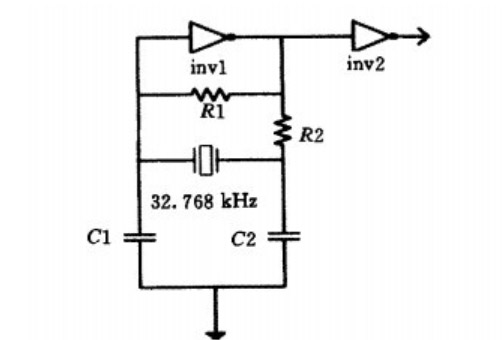
The figure illustrates the complete crystal circuit. Resistor R1biases the inverter INV1, enabling its MOSFET to operate in the saturation region for higher gain. Capacitors C1, C2, and stray capacitances form the crystal’s capacitive load. Together with inverter INV1, they act as an equivalent negative resistance, supplying energy for crystal oscillation. Resistor R2limits the drive energy to the crystal, preventing damage or abnormal crystals. Inverter INV2shapes the output waveform from INV1and drives the load.
4. Relationship Between 32.768 kHz and RTC
Real-Time Clocks (RTCs), serving as core modules for timekeeping in electronic devices, rely heavily on stable and accurate clock sources. The 32.768 kHz crystal oscillator plays a pivotal role in this regard.
In RTC operation, time measurement is achieved through a series of precise counting processes. The 32.768 kHz signal serves as the foundation for this counting mechanism. Since RTCs require precision down to the second or finer granularity, the advantages of 32.768 kHz become evident. This specific frequency, through dedicated circuitry and logic, is accurately converted into a 1 Hz signal.
Specifically, applying precise frequency division to the 32.768 kHz signal generates a stable 1 Hz pulse within the RTC. Each 1 Hz pulse corresponds to one second, forming the basis of second-level timing. Building on this, the RTC uses internal counters and registers to accumulate minutes, hours, days, and other time units, synchronized to the 1 Hz signal derived from 32.768 kHz.
Applications and Impact of Accuracy:
- In smartphones, alarm clocks, reminders, and schedules depend on RTC accuracy. Deviations in the 32.768 kHz signal may cause alarms to trigger early/late or disrupt schedules.
- On computer motherboards, system time synchronization, file timestamping, and time-sensitive applications rely on RTC precision. Inaccurate signals can lead to system time errors and software malfunctions.
- For wearables like smartwatches, compact designs demand even stricter timing precision. Signal quality directly impacts time display accuracy and user experience.
Stability Considerations:
The stability of the 32.768 kHz signal is crucial for long-term RTC accuracy. Environmental factors like temperature fluctuations or electromagnetic interference can affect oscillator performance. Even minor frequency deviations, if sustained, accumulate over time and cause significant timing errors. Thus, engineers designing RTC circuits must implement measures to ensure the 32.768 kHz crystal operates optimally, guaranteeing high precision and reliability.
Role of 32.768 kHz in Circuit Design
время выдачи: 2025-05-14 13:45:23
In the field of electronic circuits, 32.768 kHz (32768 Hz) holds a special status and plays a critical role.
1. Reasons for Adopting 32.768 kHz
The 32.768 kHz frequency is widely used in circuit design primarily due to its unique mathematical properties. This frequency value can be easily divided to generate various common time benchmarks. For example, applying 15 successive binary divisions (halving) to this frequency produces a precise 1 Hz signal, which is essential for implementing second-based timing functions. Additionally, crystal oscillators operating at this frequency exhibit high stability, maintaining relatively consistent output across varying environmental conditions. This ensures accurate and reliable clock signals for circuits, meeting the demands of applications requiring high timekeeping precision, such as Real-Time Clocks (RTCs).
2. Selection of External Load for 32.768 kHz Crystals
The external load significantly impacts the performance of a 32.768 kHz crystal oscillator. Proper selection of load capacitance is critical. The load capacitance value must align with the crystal’s specifications and the circuit’s requirements. Incorrect load capacitance can cause frequency deviation in the crystals, compromising timing accuracy. Common load capacitance values include 7 pF, 9 pF, and 12.5 pF. During circuit design, the internal capacitance of the connected chip pins must be considered, and external load capacitance should be calculated to ensure the oscillator operates near its nominal frequency.
The table below lists typical external capacitor values for common loads:
Crystal Load Capacitance | External Capacitor Values |
7PF | 12~15PF |
9PF | 15~18PF |
12.5PF | 18~22PF |
*Note: Actual values should be determined through matching tests to identify the optimal external capacitance.*
3. External Circuitry for 32.768 kHz Crystals
The figure illustrates the complete crystal circuit. Resistor R1biases the inverter INV1, enabling its MOSFET to operate in the saturation region for higher gain. Capacitors C1, C2, and stray capacitances form the crystal’s capacitive load. Together with inverter INV1, they act as an equivalent negative resistance, supplying energy for crystal oscillation. Resistor R2limits the drive energy to the crystal, preventing damage or abnormal crystals. Inverter INV2shapes the output waveform from INV1and drives the load.
4. Relationship Between 32.768 kHz and RTC
Real-Time Clocks (RTCs), serving as core modules for timekeeping in electronic devices, rely heavily on stable and accurate clock sources. The 32.768 kHz crystal oscillator plays a pivotal role in this regard.
In RTC operation, time measurement is achieved through a series of precise counting processes. The 32.768 kHz signal serves as the foundation for this counting mechanism. Since RTCs require precision down to the second or finer granularity, the advantages of 32.768 kHz become evident. This specific frequency, through dedicated circuitry and logic, is accurately converted into a 1 Hz signal.
Specifically, applying precise frequency division to the 32.768 kHz signal generates a stable 1 Hz pulse within the RTC. Each 1 Hz pulse corresponds to one second, forming the basis of second-level timing. Building on this, the RTC uses internal counters and registers to accumulate minutes, hours, days, and other time units, synchronized to the 1 Hz signal derived from 32.768 kHz.
Applications and Impact of Accuracy:
- In smartphones, alarm clocks, reminders, and schedules depend on RTC accuracy. Deviations in the 32.768 kHz signal may cause alarms to trigger early/late or disrupt schedules.
- On computer motherboards, system time synchronization, file timestamping, and time-sensitive applications rely on RTC precision. Inaccurate signals can lead to system time errors and software malfunctions.
- For wearables like smartwatches, compact designs demand even stricter timing precision. Signal quality directly impacts time display accuracy and user experience.
Stability Considerations:
The stability of the 32.768 kHz signal is crucial for long-term RTC accuracy. Environmental factors like temperature fluctuations or electromagnetic interference can affect oscillator performance. Even minor frequency deviations, if sustained, accumulate over time and cause significant timing errors. Thus, engineers designing RTC circuits must implement measures to ensure the 32.768 kHz crystal operates optimally, guaranteeing high precision and reliability.
Связанные статьи
-

YXC YSN8111: сверхмалопотребляющие часы реального времени 250 нА для носимой электроники
-
Основы синхронизации SiTime PNT: почему прецизионные генераторы определяют навигацию
-
Чип RTC, совместимый с DS1302ZN: D1302F — высокоточные часы реального времени с промышленным диапазоном температур
-
Зачем ИИ-серверам дифференциальные кварцевые генераторы: гид по выбору тактирования (2026)
-
Стандарт GB 14287.7: силовые модули Jinlan прошли производственную валидацию
-
YXC DIP SAW устройства: руководство по выбору резонаторов и фильтров для ISM диапазона
-
SiT9375: дифференциальный MEMS-генератор с рекордно низким джиттером 150 фс и самым маленьким в отрасли корпусом 2,0×1,6 мм
-
SiC IPM от NCE-Guiguo: карбидокремниевые интеллектуальные модули для нового поколения силовой электроники
-
EPSON демонстрирует ИИМ на Международной выставке низковысотной экономики 2026 — YQM ELECTRONICS как официальный дистрибьютор
-
на EMAX Asia 2026: расширение глобального присутствия в Пенанге, Малайзия


Copyright By © YQM ELECTRONICS INTL LIMITED SITEMAP
Email: sales@yqmec.com

点击右上角
分享给朋友吧


