
How a Crystal Oscillator Becomes the "Heartbeat Engine" of a Car Remote
Time: 2026-03-16 19:56:43
One gentle press, and your vehicle unlocks
Behind this everyday action,
lies a crystal oscillator, smaller than a fingertip, precisely commanding every signal transmission.
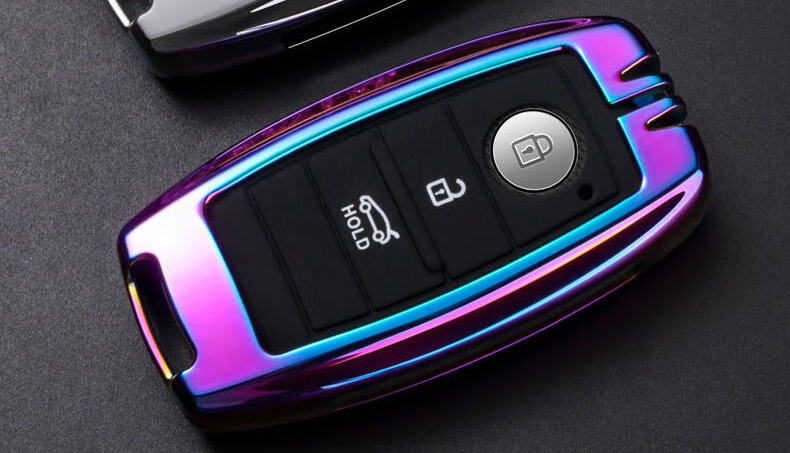
A press of the car key, the lights flash, the door unlocks – behind this seemingly simple sequence lies the precision timing network of modern automotive electronics. The crystal oscillator, the core component inside the car remote, serves as the 'heartbeat' engine of this entire system.
The crystal oscillator generates a precise frequency signal through the inverse piezoelectric effect of the quartz crystal, providing an accurate timing reference for the microcontroller within the remote.
YXC ------ Making Every Press, Unfailingly Accurate
Small Remote, Giant Tech Core.
The car remote key has evolved from a simple mechanical tool replacement into a core electronic device integrating keyless entry, intelligent control, security, anti-theft, and personalized services. It greatly enhances the convenience, safety, and comfort of vehicle use, serving as a crucial gateway to the modern smart car interactive experience.
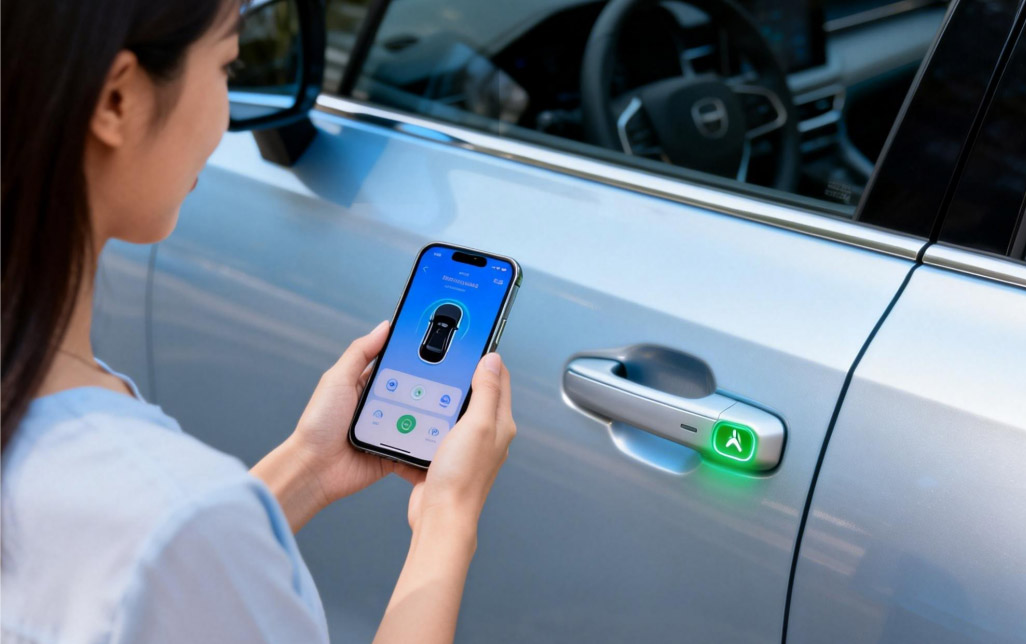
The Critical Role of Crystal Oscillators in Car Remotes
The crystal oscillator performs three core functions in this process:
· Providing the Reference Frequency: Supplies the system clock for the MCU, ensuring program logic executes on time.
· Ensuring RF Stability: Provides the carrier frequency reference for the RF transmission module, preventing communication failure due to frequency drift.
· Enhancing Anti-interference Capability: The high Q-value of the quartz crystal offers excellent frequency stability, maintaining performance under harsh conditions like temperature variations and shocks.
Especially in automotive environments, the remote must endure temperature ranges from -40℃ to +85℃ or wider, frequent drop impacts, and electromagnetic interference. This imposes stringent reliability requirements on the crystal oscillator.
Generational Evolution of Automotive Wireless Technology and Crystal Oscillator Selection
We categorize the technological evolution of car keys into three stages, detailing the origin of frequency points, accuracy requirements, and packaging standards for each stage:
1. Traditional RKE/PKE Stage (RF Remote & NFC Emergency Module)
This is currently the most widely adopted solution. The RF chip uses an internal Phase-Locked Loop (PLL) to multiply the crystal's fundamental frequency, generating UHF band signals. It is extremely sensitive to center frequency alignment and startup speed.
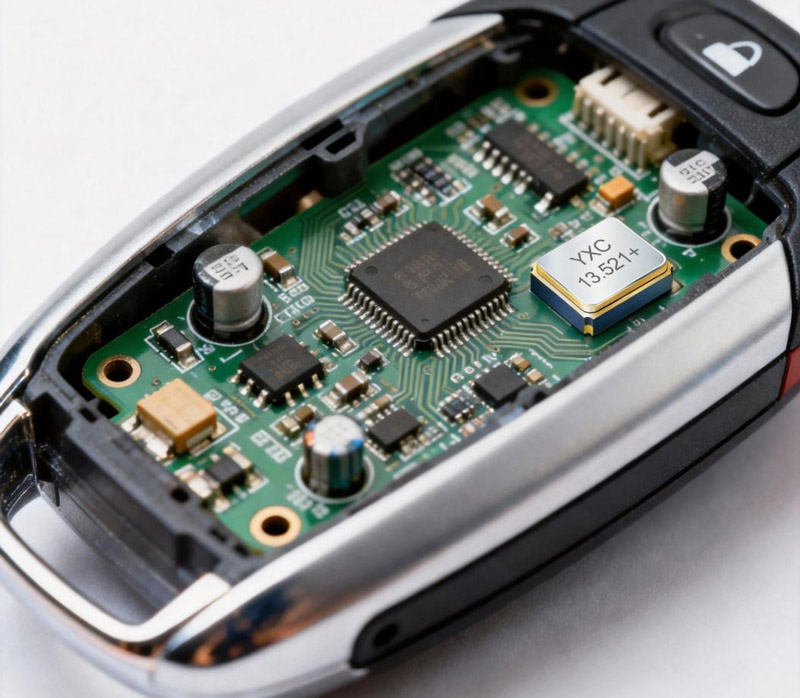
RF Remote Module (RKE/PKE): Responsible for vehicle control within 30-50 meters.
a. 13.560MHz / 13.52127MHz: Corresponds to the globally common 433.92MHz transmission frequency. Among these, 13.52127MHz is a precision offset frequency point specifically designed to match the divider algorithm of certain chips, ensuring the transmitted signal is precisely locked onto the center channel for optimal reception sensitivity.
b. 9.84375MHz: Corresponds to the 315MHz transmission frequency commonly used in the US and Japanese markets.
c. 27.1412MHz: A classic 27MHz band solution used in some early American vehicles and industrial wireless remote controls.
d. Selection Requirements: 3.2x2.5mm or 2.0x1.6mm package passive crystal oscillator, accuracy ±20ppm. Critical attention must be paid to ESR (Equivalent Series Resistance) to ensure rapid startup even under low battery voltage conditions (coin cell).
NFC Emergency Induction Module: Acts as an independent hardware link, ensuring the key can still open the door via near-field induction even when the battery is completely dead.
a. 27.120MHz: The standard fundamental frequency for modern automotive NFC controllers, supporting the 13.56 MHz carrier handshake.
b. Selection Requirements: 3.2x2.5mm or 2.0x1.6mm package passive crystal oscillator. As the 'last line of defense' in emergencies, extremely high mechanical strength and impact resistance are required, necessitating strict compliance with AEC-Q200 certification.
2. BLE Digital Key Stage (Bluetooth Access)
With the increasing popularity of smartphone digital keys, Bluetooth Low Energy (BLE) has become the mainstream choice for authentication and passive entry. Frequent, fast connections are needed between the vehicle node and the phone/smart key.
Technical Core: The Bluetooth frequency hopping mechanism demands extremely high frequency stability. Excessive frequency deviation can lead to connection timeouts or data retransmission, ruining the seamless 'approach and unlock' user experience.
Core Frequency: 32.000MHz
Selection Requirements: Frequency accuracy tightened to ±10ppm. Must pass AEC-Q200 certification. High-precision crystals significantly reduce connection setup time and effectively lower system standby power consumption.
UWB Digital Key Stage (Centimeter-Level Precision Positioning)
The introduction of Ultra-Wideband (UWB) technology brings precise spatial awareness to digital keys. Its underlying logic shifts from phase modulation to Time-of-Flight (ToF) measurement, making it extremely sensitive to timing drift.
Technical Core: In the ToF mechanism, a 1 ns timing error translates to a 30 cm error in spatial distance. The temperature drift characteristics of standard crystal oscillators are completely inadequate for supporting UWB's high-precision positioning algorithms.
Core Frequency: 38.400 MHz
Selection Requirements: The use of a Temperature Compensated Crystal Oscillator (TCXO) is mandatory. Accuracy must reach ±2ppm. The TCXO suppresses temperature drift via internal compensation circuitry, making it the only solution capable of achieving the centimeter-level precision interaction required by CCC specifications.
Application Case
YXC's automotive-grade resonators are now widely used by Tier 1 and Tier 2 core suppliers in the automotive industry chain. They deeply penetrate various electronic systems, including intelligent driving, telematics, and in-car entertainment, establishing YXC as a key 'heartbeat' component driving the advancement of domestic automotive electronics towards high-level intelligence.
How a Crystal Oscillator Becomes the "Heartbeat Engine" of a Car Remote
Time: 2026-03-16 19:56:43
One gentle press, and your vehicle unlocks
Behind this everyday action,
lies a crystal oscillator, smaller than a fingertip, precisely commanding every signal transmission.
A press of the car key, the lights flash, the door unlocks – behind this seemingly simple sequence lies the precision timing network of modern automotive electronics. The crystal oscillator, the core component inside the car remote, serves as the 'heartbeat' engine of this entire system.
The crystal oscillator generates a precise frequency signal through the inverse piezoelectric effect of the quartz crystal, providing an accurate timing reference for the microcontroller within the remote.
YXC ------ Making Every Press, Unfailingly Accurate
Small Remote, Giant Tech Core.
The car remote key has evolved from a simple mechanical tool replacement into a core electronic device integrating keyless entry, intelligent control, security, anti-theft, and personalized services. It greatly enhances the convenience, safety, and comfort of vehicle use, serving as a crucial gateway to the modern smart car interactive experience.
The Critical Role of Crystal Oscillators in Car Remotes
The crystal oscillator performs three core functions in this process:
· Providing the Reference Frequency: Supplies the system clock for the MCU, ensuring program logic executes on time.
· Ensuring RF Stability: Provides the carrier frequency reference for the RF transmission module, preventing communication failure due to frequency drift.
· Enhancing Anti-interference Capability: The high Q-value of the quartz crystal offers excellent frequency stability, maintaining performance under harsh conditions like temperature variations and shocks.
Especially in automotive environments, the remote must endure temperature ranges from -40℃ to +85℃ or wider, frequent drop impacts, and electromagnetic interference. This imposes stringent reliability requirements on the crystal oscillator.
Generational Evolution of Automotive Wireless Technology and Crystal Oscillator Selection
We categorize the technological evolution of car keys into three stages, detailing the origin of frequency points, accuracy requirements, and packaging standards for each stage:
1. Traditional RKE/PKE Stage (RF Remote & NFC Emergency Module)
This is currently the most widely adopted solution. The RF chip uses an internal Phase-Locked Loop (PLL) to multiply the crystal's fundamental frequency, generating UHF band signals. It is extremely sensitive to center frequency alignment and startup speed.
RF Remote Module (RKE/PKE): Responsible for vehicle control within 30-50 meters.
a. 13.560MHz / 13.52127MHz: Corresponds to the globally common 433.92MHz transmission frequency. Among these, 13.52127MHz is a precision offset frequency point specifically designed to match the divider algorithm of certain chips, ensuring the transmitted signal is precisely locked onto the center channel for optimal reception sensitivity.
b. 9.84375MHz: Corresponds to the 315MHz transmission frequency commonly used in the US and Japanese markets.
c. 27.1412MHz: A classic 27MHz band solution used in some early American vehicles and industrial wireless remote controls.
d. Selection Requirements: 3.2x2.5mm or 2.0x1.6mm package passive crystal oscillator, accuracy ±20ppm. Critical attention must be paid to ESR (Equivalent Series Resistance) to ensure rapid startup even under low battery voltage conditions (coin cell).
NFC Emergency Induction Module: Acts as an independent hardware link, ensuring the key can still open the door via near-field induction even when the battery is completely dead.
a. 27.120MHz: The standard fundamental frequency for modern automotive NFC controllers, supporting the 13.56 MHz carrier handshake.
b. Selection Requirements: 3.2x2.5mm or 2.0x1.6mm package passive crystal oscillator. As the 'last line of defense' in emergencies, extremely high mechanical strength and impact resistance are required, necessitating strict compliance with AEC-Q200 certification.
2. BLE Digital Key Stage (Bluetooth Access)
With the increasing popularity of smartphone digital keys, Bluetooth Low Energy (BLE) has become the mainstream choice for authentication and passive entry. Frequent, fast connections are needed between the vehicle node and the phone/smart key.
Technical Core: The Bluetooth frequency hopping mechanism demands extremely high frequency stability. Excessive frequency deviation can lead to connection timeouts or data retransmission, ruining the seamless 'approach and unlock' user experience.
Core Frequency: 32.000MHz
Selection Requirements: Frequency accuracy tightened to ±10ppm. Must pass AEC-Q200 certification. High-precision crystals significantly reduce connection setup time and effectively lower system standby power consumption.
UWB Digital Key Stage (Centimeter-Level Precision Positioning)
The introduction of Ultra-Wideband (UWB) technology brings precise spatial awareness to digital keys. Its underlying logic shifts from phase modulation to Time-of-Flight (ToF) measurement, making it extremely sensitive to timing drift.
Technical Core: In the ToF mechanism, a 1 ns timing error translates to a 30 cm error in spatial distance. The temperature drift characteristics of standard crystal oscillators are completely inadequate for supporting UWB's high-precision positioning algorithms.
Core Frequency: 38.400 MHz
Selection Requirements: The use of a Temperature Compensated Crystal Oscillator (TCXO) is mandatory. Accuracy must reach ±2ppm. The TCXO suppresses temperature drift via internal compensation circuitry, making it the only solution capable of achieving the centimeter-level precision interaction required by CCC specifications.
Application Case
YXC's automotive-grade resonators are now widely used by Tier 1 and Tier 2 core suppliers in the automotive industry chain. They deeply penetrate various electronic systems, including intelligent driving, telematics, and in-car entertainment, establishing YXC as a key 'heartbeat' component driving the advancement of domestic automotive electronics towards high-level intelligence.
Other Articles
-

Role of 32.768 kHz in Circuit Design
-
SiTime Automotive Oscillators
-
The Role of 32.768kHz in Circuits
-
11.0592MHz Crystal Oscillator: The "Heart" of the Computer Motherboard?
-
Epson RTC modules solve three major pain points of ioT
-
Examine the cost and design considerations of crystals and oscillators
-
Exploring how YXC oscillators show their skills to help with AI servers
-
Lessons from the Middle East Events — The Importance of Localization!
-
Honeywell HH760 Handheld 2D Area Imager Barcode Scanner
-
YXC Active Differential Programmable Crystal Oscillator Supports 5G Base Station Applications


Copyright By © YQM ELECTRONICS INTL LIMITED SITEMAP
Email: sales@yqmec.com

点击右上角
分享给朋友吧


