
YQ8025T RTC: Built-in DTCXO, No Crystal — RX8025T Alternative
Time: 2026-10-12 10:23:47
Most RTC headaches on a bill of materials are not clock problems — they are crystal problems. The 32.768kHz crystal sitting next to the RTC has to be specified, matched with the right load capacitors, placed close to the IC, and protected from the layout around it. YQ8025T removes that entire exercise: it is a high-precision calendar real-time clock with an integrated digital temperature-compensated crystal oscillator (DTCXO), so the 32.768kHz reference and its temperature compensation live inside the package instead of beside it. For teams designing around the EPSON RX8025T family, it is a directly comparable YQ8025T high-precision DTCXO RTC with an I²C host interface, a 1.6–5.5 V supply window and an LGA14 footprint.
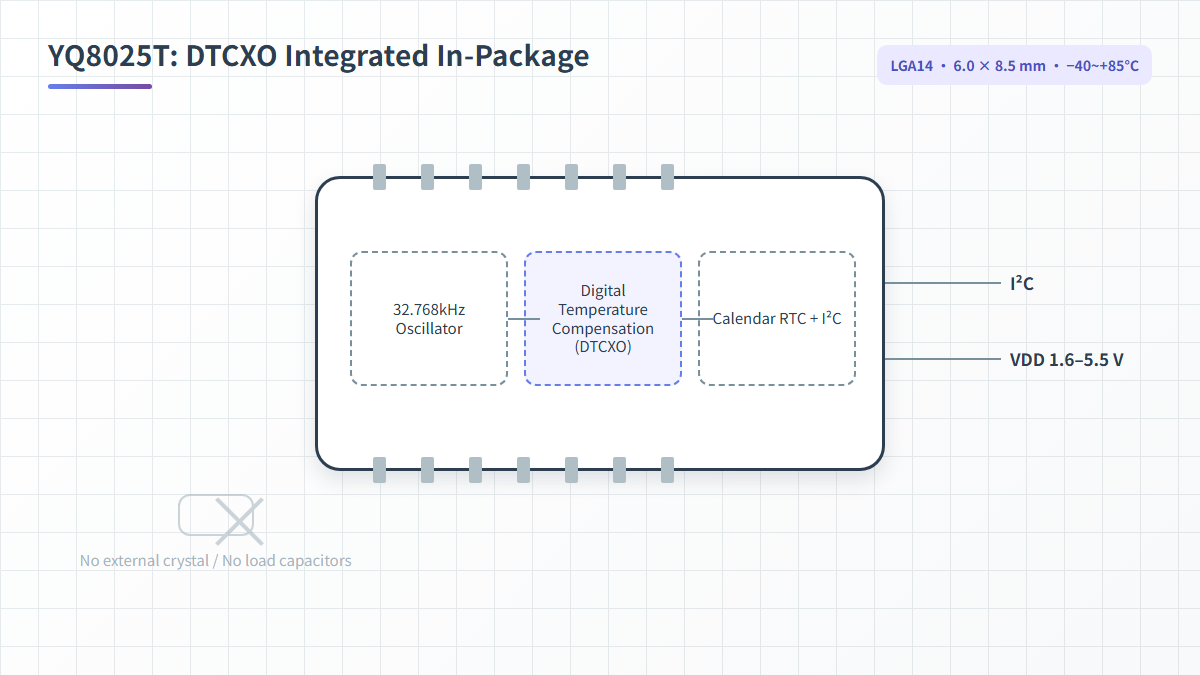
Figure 1: Inside the YQ8025T — 32.768kHz oscillator, digital temperature compensation and calendar RTC integrated in one LGA14 package, with no external crystal or matching capacitors required.
1. What a Built-in DTCXO Removes From Your Design
Splitting timekeeping into 'RTC IC plus external crystal' is a long-standing habit, but every element of that arrangement is a variable you have to manage. Integrating the DTCXO collapses those variables into one qualified part:
- No external crystal: the 32.768kHz DTCXO is integrated, so there is no second part number to specify, qualify, second-source or hold in stock.
- No matching capacitors: load-capacitance selection — and the tolerance spread that comes with it — disappears from the BOM.
- Simplified PCB: no crystal keep-out zone, no short matched trace pair, no ground guard ring around the oscillator. That board area and those layout constraints go back to the rest of the design.
- Compensation matched in the factory: the digital temperature-compensation network is characterised together with the oscillator it corrects, which is what keeps timekeeping at full-temperature high precision across the industrial range rather than at room temperature only.
2. YQ8025T Key Specifications
The parameters designers check first are listed below. Confirm final values against the latest official datasheet for your specific lot and operating conditions before committing a design.
| Parameter | YQ8025T |
|---|---|
| Function | High-precision calendar real-time clock (RTC) |
| Timekeeping oscillator | Built-in 32.768kHz DTCXO (digital temperature-compensated crystal oscillator) — no external crystal |
| Host interface | I²C |
| Supply voltage | 1.6 V to 5.5 V |
| Power profile | Low power — suitable for long-term timekeeping from a coin-cell backup battery |
| Timekeeping accuracy | Full-temperature high precision across the industrial temperature range |
| Operating temperature | −40°C to +85°C |
| Package | LGA14 |
| Dimensions | 6.0 × 8.5 mm |
| Typical applications | Smart metering · industrial data logging and acquisition · energy storage and power equipment · portable medical devices |
3. Replacing the EPSON RX8025T: What to Check First
The EPSON RX8025T family has been a default choice for temperature-compensated timekeeping for years. Its variants — RX-8025T-UB, RX-8025T-UC and RX-8025NB — sit in a very large installed base of utility meters, data loggers and industrial controllers, and that installed base is exactly why a second source is worth qualifying. Work through these four points in order:
- Supply window: YQ8025T runs from 1.6 V to 5.5 V, which covers 3.3 V and 5 V rails as well as the falling voltage of a backup cell.
- Host interface: I²C — confirm bus speed, pull-up values and device addressing against your existing firmware before you touch the layout.
- Package and footprint: LGA14 at 6.0 × 8.5 mm. Verify the land pattern, height clearance and reflow profile on your board.
- Function set: compare the calendar and register behaviour against the way your firmware reads and writes time, then validate with samples on your own hardware.
Pull the RX8025T variant datasheets from our EPSON product range page and line them up against YQ8025T. Running an EPSON part and a domestic DTCXO RTC side by side achieves two things at once: a validated replacement path, and a genuine second source for the same socket.
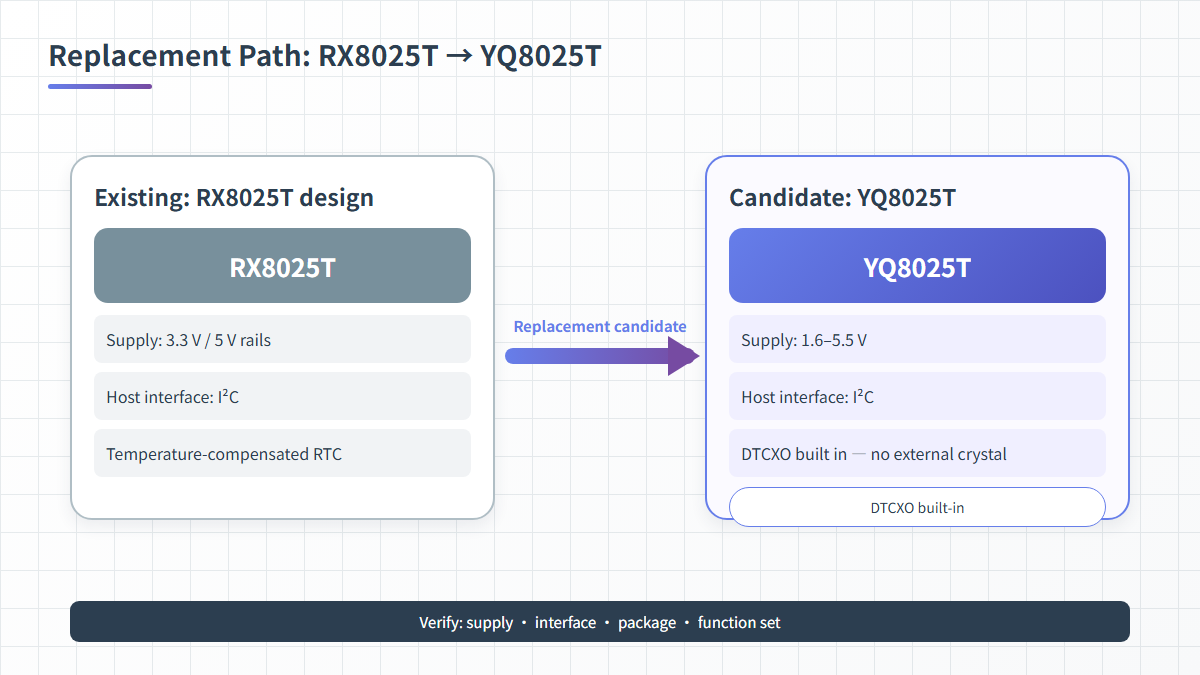
Figure 2: RX8025T to YQ8025T replacement path — verify supply, interface, package and function set before adopting the candidate.
4. YQ8025T vs YQ8563: Two Different Crystal Strategies
Both are YQM real-time clocks and both keep time against a 32.768kHz reference — but they answer the crystal question differently, and that is the first decision to settle when choosing between them.
| Point | YQ8025T | YQ8563 |
|---|---|---|
| Timekeeping reference | Built-in 32.768kHz DTCXO | External 32.768kHz crystal |
| External crystal | Not required | Required |
| Matching capacitors | Not required | Required — sized to the chosen crystal |
| Temperature compensation | Digital, integrated with the oscillator in-package | Set by the external crystal and the circuit around it |
| PCB impact | Simplified — no crystal placement, keep-out or matched trace pair | Crystal placement, routing and guard ring required |
| Choose it when | Board space is tight, placement risk matters, or you want compensation matched in the factory | You already hold a qualified crystal, or you want to select it yourself |
In one line: YQ8025T integrates the oscillator; YQ8563 expects you to supply it. The YQ8563 real-time clock is the right route when the crystal is already a settled decision in your design.
5. Where YQ8025T Fits
| Application | What the built-in DTCXO brings |
|---|---|
| Smart metering (main volume application) | Timekeeping that has to stay trustworthy for years on a backup cell, with no crystal to age or shift inside a sealed enclosure |
| Industrial data logging and acquisition | Time stamps that stay ordered when the enclosure sees the full industrial temperature range |
| Energy storage and power equipment | Dependable event timing in cabinets where the crystal-and-capacitor arrangement is the usual weak point |
| Portable medical devices | Compact LGA14 footprint and a 1.6–5.5 V supply window for battery-powered designs |
6. FAQ
Q: Does the YQ8025T need an external 32.768kHz crystal?
A: No. The 32.768kHz DTCXO — the oscillator and its digital temperature compensation — is integrated in the package, so you add neither a crystal nor a pair of matching capacitors.
Q: Can the YQ8025T replace an EPSON RX8025T?
A: It targets the same class of function: a high-precision calendar RTC with integrated temperature compensation and an I²C host interface, in a compact SMD package. Treat it as a replacement candidate — verify supply voltage, interface, footprint and function set against your RX8025T design, then confirm on your own board with samples.
Q: What is the difference between the YQ8025T and the YQ8563?
A: The crystal strategy. YQ8025T has the DTCXO built in and needs no external crystal or matching capacitors. YQ8563 uses an external 32.768kHz crystal, which you select and lay out yourself.
Q: What supply voltage, package and temperature range does it support?
A: 1.6 V to 5.5 V over an operating range of −40°C to +85°C, in an LGA14 package measuring 6.0 × 8.5 mm, with an I²C host interface.
Related pages: the RTC category, our low-power component selection, the I²C-bus low-power RTC page, the YQ8025T product page, or browse all products.
Qualifying YQ8025T for your design?
Ask our FAE team for YQ8025T datasheets, samples and a parameter-by-parameter comparison against your current EPSON RX8025T variant — typically within one business day.
Request Sample & DatasheetYQ8025T RTC: Built-in DTCXO, No Crystal — RX8025T Alternative
Time: 2026-10-12 10:23:47
Most RTC headaches on a bill of materials are not clock problems — they are crystal problems. The 32.768kHz crystal sitting next to the RTC has to be specified, matched with the right load capacitors, placed close to the IC, and protected from the layout around it. YQ8025T removes that entire exercise: it is a high-precision calendar real-time clock with an integrated digital temperature-compensated crystal oscillator (DTCXO), so the 32.768kHz reference and its temperature compensation live inside the package instead of beside it. For teams designing around the EPSON RX8025T family, it is a directly comparable YQ8025T high-precision DTCXO RTC with an I²C host interface, a 1.6–5.5 V supply window and an LGA14 footprint.
Figure 1: Inside the YQ8025T — 32.768kHz oscillator, digital temperature compensation and calendar RTC integrated in one LGA14 package, with no external crystal or matching capacitors required.
1. What a Built-in DTCXO Removes From Your Design
Splitting timekeeping into 'RTC IC plus external crystal' is a long-standing habit, but every element of that arrangement is a variable you have to manage. Integrating the DTCXO collapses those variables into one qualified part:
- No external crystal: the 32.768kHz DTCXO is integrated, so there is no second part number to specify, qualify, second-source or hold in stock.
- No matching capacitors: load-capacitance selection — and the tolerance spread that comes with it — disappears from the BOM.
- Simplified PCB: no crystal keep-out zone, no short matched trace pair, no ground guard ring around the oscillator. That board area and those layout constraints go back to the rest of the design.
- Compensation matched in the factory: the digital temperature-compensation network is characterised together with the oscillator it corrects, which is what keeps timekeeping at full-temperature high precision across the industrial range rather than at room temperature only.
2. YQ8025T Key Specifications
The parameters designers check first are listed below. Confirm final values against the latest official datasheet for your specific lot and operating conditions before committing a design.
| Parameter | YQ8025T |
|---|---|
| Function | High-precision calendar real-time clock (RTC) |
| Timekeeping oscillator | Built-in 32.768kHz DTCXO (digital temperature-compensated crystal oscillator) — no external crystal |
| Host interface | I²C |
| Supply voltage | 1.6 V to 5.5 V |
| Power profile | Low power — suitable for long-term timekeeping from a coin-cell backup battery |
| Timekeeping accuracy | Full-temperature high precision across the industrial temperature range |
| Operating temperature | −40°C to +85°C |
| Package | LGA14 |
| Dimensions | 6.0 × 8.5 mm |
| Typical applications | Smart metering · industrial data logging and acquisition · energy storage and power equipment · portable medical devices |
3. Replacing the EPSON RX8025T: What to Check First
The EPSON RX8025T family has been a default choice for temperature-compensated timekeeping for years. Its variants — RX-8025T-UB, RX-8025T-UC and RX-8025NB — sit in a very large installed base of utility meters, data loggers and industrial controllers, and that installed base is exactly why a second source is worth qualifying. Work through these four points in order:
- Supply window: YQ8025T runs from 1.6 V to 5.5 V, which covers 3.3 V and 5 V rails as well as the falling voltage of a backup cell.
- Host interface: I²C — confirm bus speed, pull-up values and device addressing against your existing firmware before you touch the layout.
- Package and footprint: LGA14 at 6.0 × 8.5 mm. Verify the land pattern, height clearance and reflow profile on your board.
- Function set: compare the calendar and register behaviour against the way your firmware reads and writes time, then validate with samples on your own hardware.
Pull the RX8025T variant datasheets from our EPSON product range page and line them up against YQ8025T. Running an EPSON part and a domestic DTCXO RTC side by side achieves two things at once: a validated replacement path, and a genuine second source for the same socket.
Figure 2: RX8025T to YQ8025T replacement path — verify supply, interface, package and function set before adopting the candidate.
4. YQ8025T vs YQ8563: Two Different Crystal Strategies
Both are YQM real-time clocks and both keep time against a 32.768kHz reference — but they answer the crystal question differently, and that is the first decision to settle when choosing between them.
| Point | YQ8025T | YQ8563 |
|---|---|---|
| Timekeeping reference | Built-in 32.768kHz DTCXO | External 32.768kHz crystal |
| External crystal | Not required | Required |
| Matching capacitors | Not required | Required — sized to the chosen crystal |
| Temperature compensation | Digital, integrated with the oscillator in-package | Set by the external crystal and the circuit around it |
| PCB impact | Simplified — no crystal placement, keep-out or matched trace pair | Crystal placement, routing and guard ring required |
| Choose it when | Board space is tight, placement risk matters, or you want compensation matched in the factory | You already hold a qualified crystal, or you want to select it yourself |
In one line: YQ8025T integrates the oscillator; YQ8563 expects you to supply it. The YQ8563 real-time clock is the right route when the crystal is already a settled decision in your design.
5. Where YQ8025T Fits
| Application | What the built-in DTCXO brings |
|---|---|
| Smart metering (main volume application) | Timekeeping that has to stay trustworthy for years on a backup cell, with no crystal to age or shift inside a sealed enclosure |
| Industrial data logging and acquisition | Time stamps that stay ordered when the enclosure sees the full industrial temperature range |
| Energy storage and power equipment | Dependable event timing in cabinets where the crystal-and-capacitor arrangement is the usual weak point |
| Portable medical devices | Compact LGA14 footprint and a 1.6–5.5 V supply window for battery-powered designs |
6. FAQ
Q: Does the YQ8025T need an external 32.768kHz crystal?
A: No. The 32.768kHz DTCXO — the oscillator and its digital temperature compensation — is integrated in the package, so you add neither a crystal nor a pair of matching capacitors.
Q: Can the YQ8025T replace an EPSON RX8025T?
A: It targets the same class of function: a high-precision calendar RTC with integrated temperature compensation and an I²C host interface, in a compact SMD package. Treat it as a replacement candidate — verify supply voltage, interface, footprint and function set against your RX8025T design, then confirm on your own board with samples.
Q: What is the difference between the YQ8025T and the YQ8563?
A: The crystal strategy. YQ8025T has the DTCXO built in and needs no external crystal or matching capacitors. YQ8563 uses an external 32.768kHz crystal, which you select and lay out yourself.
Q: What supply voltage, package and temperature range does it support?
A: 1.6 V to 5.5 V over an operating range of −40°C to +85°C, in an LGA14 package measuring 6.0 × 8.5 mm, with an I²C host interface.
Related pages: the RTC category, our low-power component selection, the I²C-bus low-power RTC page, the YQ8025T product page, or browse all products.
Qualifying YQ8025T for your design?
Ask our FAE team for YQ8025T datasheets, samples and a parameter-by-parameter comparison against your current EPSON RX8025T variant — typically within one business day.
Request Sample & DatasheetOther Articles
-

Role of 32.768 kHz in Circuit Design
-
SiTime Automotive Oscillators
-
The Role of 32.768kHz in Circuits
-
11.0592MHz Crystal Oscillator: The "Heart" of the Computer Motherboard?
-
Epson RTC modules solve three major pain points of ioT
-
Examine the cost and design considerations of crystals and oscillators
-
Exploring how YXC oscillators show their skills to help with AI servers
-
Lessons from the Middle East Events — The Importance of Localization!
-
Honeywell HH760 Handheld 2D Area Imager Barcode Scanner
-
YXC Active Differential Programmable Crystal Oscillator Supports 5G Base Station Applications


Copyright By © YQM ELECTRONICS INTL LIMITED SITEMAP
Email: sales@yqmec.com

点击右上角
分享给朋友吧


