
Sunlord Wire-Wound Power Inductors (SWPA/SPH/WPN/WPG): Enabling High-Performance AI Glasses
Time: 2026-09-17 12:06:19
After smartphones and TWS earbuds, AI glasses are shaping up to be the next personal smart-wear entry point. The experience bar — slim form factor, long battery life, stable connectivity and clear audiovisual output — rests almost entirely on upstream passive components: how small they are, how little they lose, how much power they pack and how well they reject interference. YQM ELECTRONICS, as a Sunlord authorized distributor, brings this entire component chain to wearable design teams.
Sunlord Electronics, drawing on years of RF, magnetic materials and precision ceramics expertise, addresses every stage of the AI glasses hardware chain — from the RF front-end through power management to the audio and high-speed signal paths — with five product lines: LTCC RF devices, antennas, RF inductors, power inductors and noise-suppression components. The goal is one chain: smaller, cooler, quieter and longer-lasting glasses.
1. Three Engineering Bottlenecks Every AI-Glasses Design Must Solve
Mainstream AI glasses hardware architectures split into MCU-level, system-level SoC, and SoC+MCU classes. Different compute levels, same three bottlenecks:
- Space constraint: internal volume is extremely tight — components must fit metric 0402/0603 packages wherever possible.
- Power constraint: a small battery must still deliver long endurance, so DCR, ACR and core loss all have to be optimized.
- Signal constraint: Wi-Fi/BT/UWB antennas coexist in one frame, MIPI/USB lanes carry high-speed data, and EMI/EMC budgets are brutally strict.
Sunlord's answer is a full-link portfolio: LTCC RF devices for the front-end, antennas for communication and positioning, RF inductors for matching and sensitivity, power inductors for the DC-DC and PMIC rails, and noise-suppression components to keep every signal clean. Together they unlock on-device AI compute and low-power long-life operation at the passive-component level.
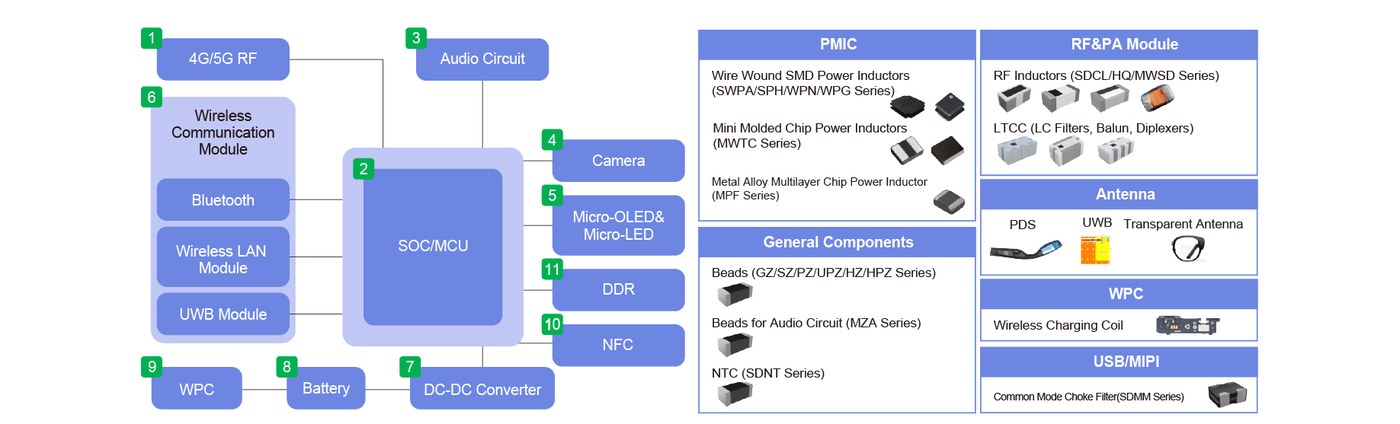
Figure 1: Sunlord AI glasses application architecture — five product lines mapped across the SOC/MCU, camera, display, battery and wireless modules.
2. LTCC RF Devices: Measured Efficiency for Wi-Fi 6E/7 and UWB
For the radio side, Sunlord's LTCC platform delivers two workhorses. The diplexer SLFD15-5R950G-03T covers the Wi-Fi 6E/7 bands:
- Insertion loss: ≤0.65 dB at 2400 MHz, ≤0.95 dB at 5150–7125 MHz;
- Out-of-band rejection: ≥15 dB at 5150–7125 MHz, ≥20 dB at 7200–7500 MHz;
- Power handling: 2.0 W — enough for high-throughput RF front-ends.
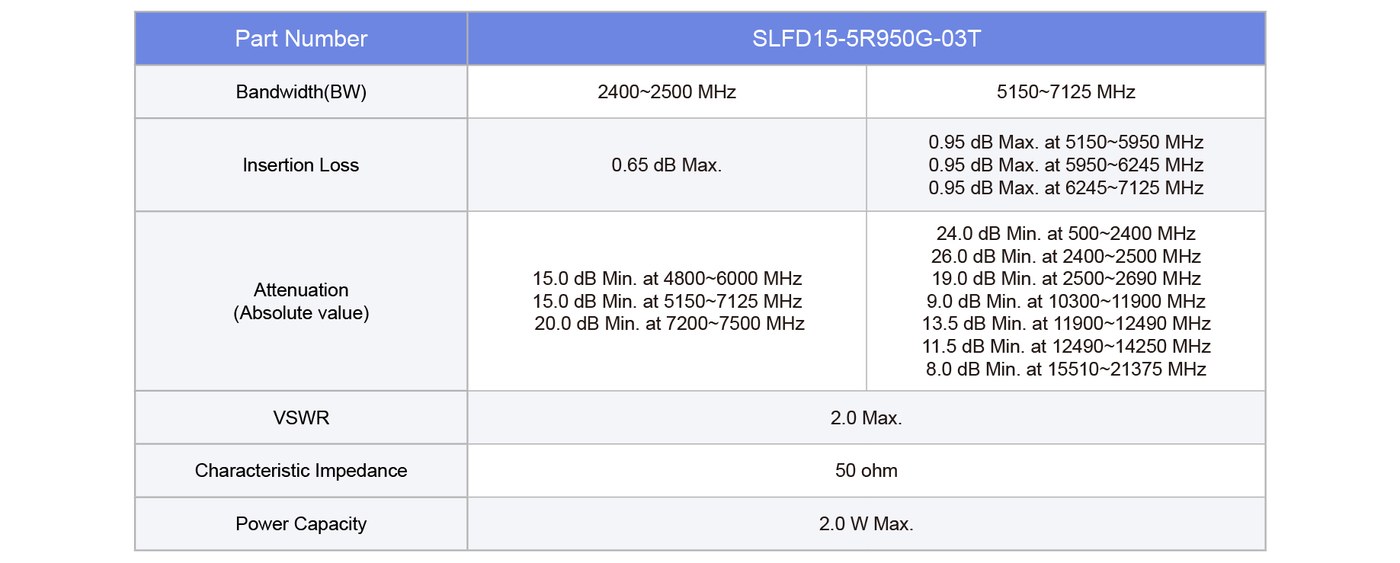
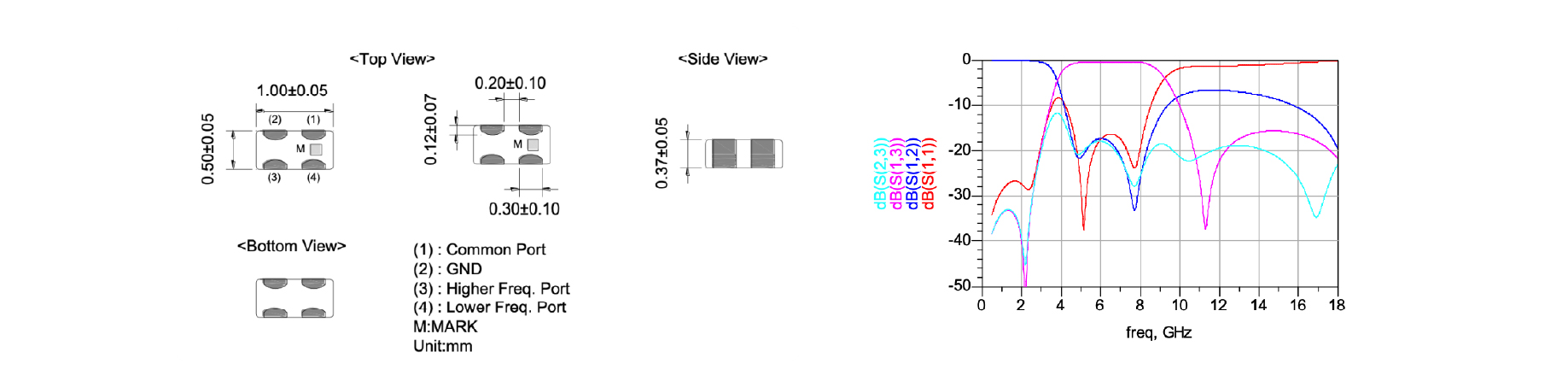
Figure 2: SLFD15-5R950G-03T — measured response and electrical specifications for the 2400 MHz and 5150–7125 MHz bands.
For UWB, the bandpass filter SLFB15-7R245G-01TF targets the 6–8 GHz channels:
- Insertion loss: ≤1.3 dB at 6240–6750 MHz, ≤1.0 dB at 7750–8250 MHz;
- Out-of-band rejection: ≥34 dB at 4000–4200 MHz, ≥30 dB at 700–2690 MHz;
- Already mass-produced for premium AR/VR equipment.
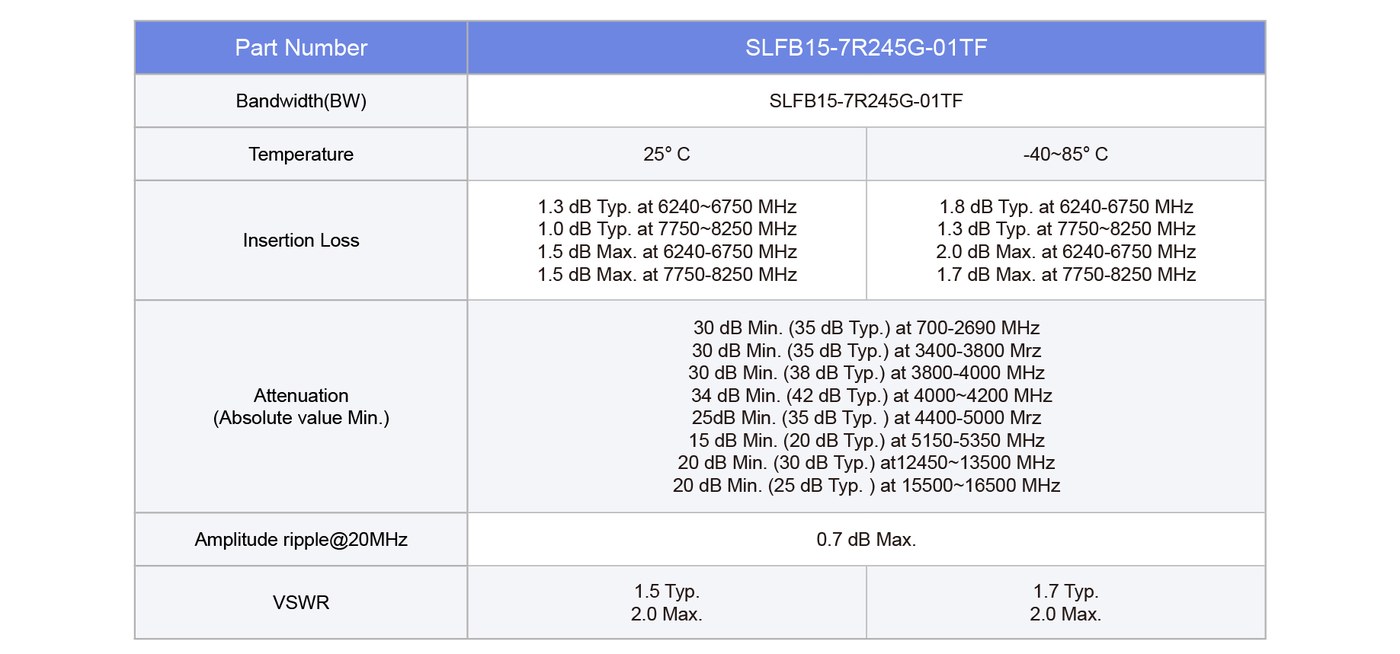

Figure 3: SLFB15-7R245G-01TF — UWB bandpass performance and full specification table, proven in AR/VR mass production.
The efficiency difference shows up where wearables live — weak signals, small batteries and crowded bands. Compared with same-class generic parts under identical test conditions, Sunlord's LTCC devices cut insertion loss by roughly 0.2–0.5 dB, which extends communication range by at least 10%–15% at the same transmit power. The higher rejection ratio also suppresses spurious radiation, lifting antenna sensitivity by about 2 dB — the margin that keeps glasses connected indoors and on the move.
3. Antenna Matrix: Conventional Antennas at Scale, Transparent Antennas for Design Freedom
Sunlord covers the complete antenna set for AI glasses — PDS antennas, UWB antennas, NFC antennas, WPC wireless charging coils and the flagship transparent antenna — balancing five requirements at once: communication, positioning, charging, sensing and appearance.
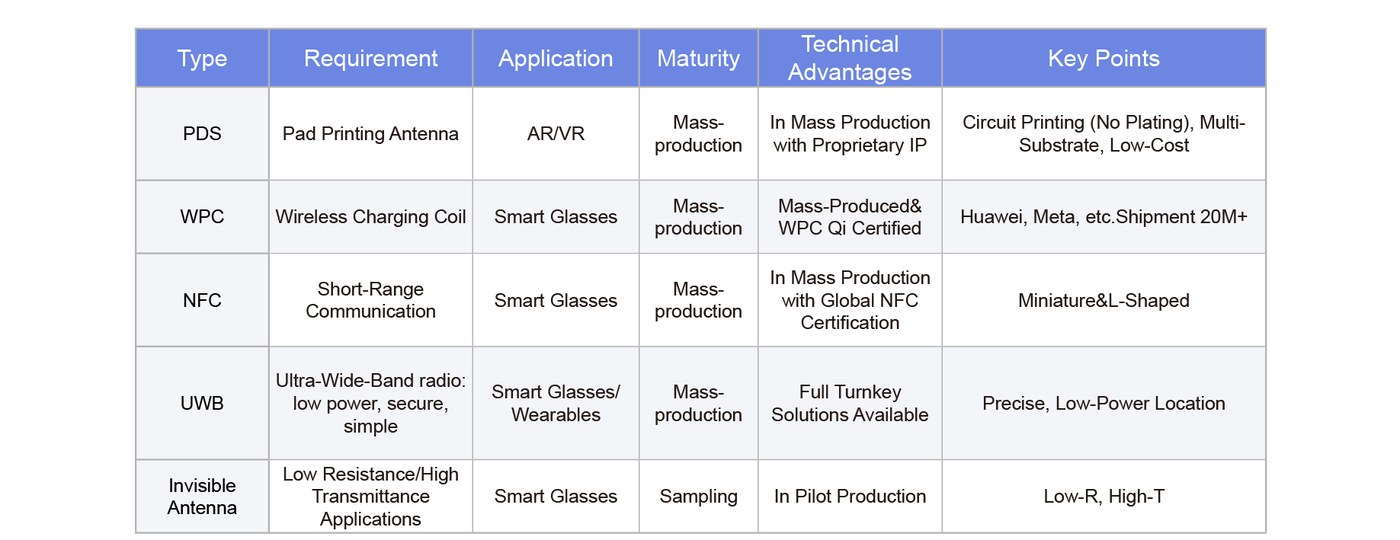

Figure 4: Sunlord AI glasses antenna matrix — from mass-produced PDS, WPC and NFC designs to UWB and transparent antennas.
Traditional AI glasses put antennas in the temples, because lenses and front frames have no room for metal radiators. Sunlord's transparent antenna, developed specifically for AI glasses, integrates directly into lenses, transparent front frames or see-through frame areas — invisible looks, unobstructed vision, undiminished communication. It supports the five high-value scenarios of AI eyewear: target recognition, perceptual communication, precise navigation, intelligent control and contactless payment.
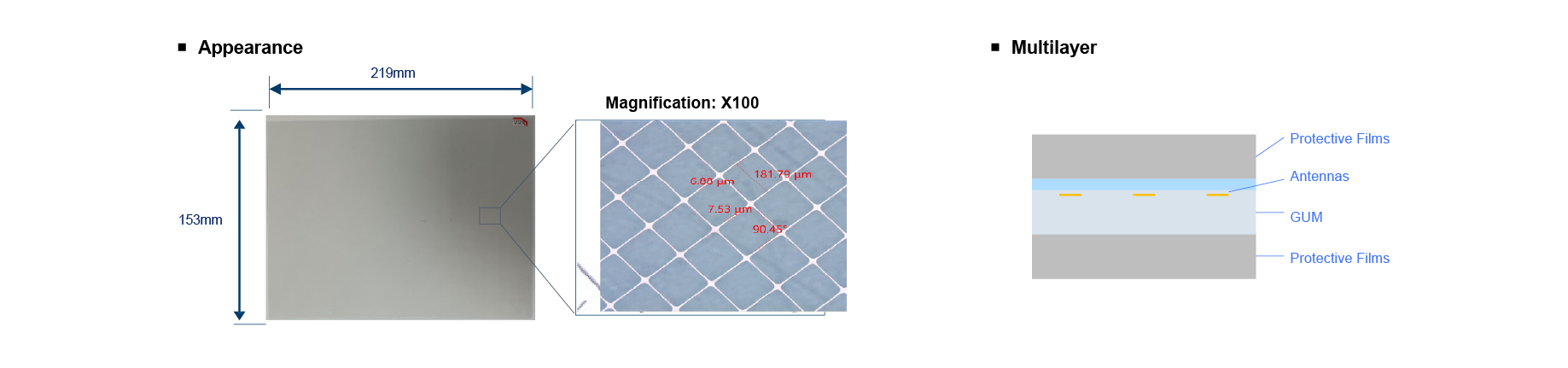
Figure 5: Sunlord transparent antenna — mounted on lenses and front frames, freeing temple space for thinner, lighter glasses.
Structure and electrical performance:
- Sheet resistance: typical 0.35 Ω/□ — low loss, high transmission efficiency;
- Frequency coverage: full Wi-Fi/BT/UWB bands;
- Communication efficiency: no lower than conventional LDS/PDS antennas;
- Dimensions: typical 153 mm × 219 mm, custom-cut to fit;
- Process: thin-film groove wiring — no metal obstruction, bend-resistant, highly reliable.
The transparent material does not block vision or design aesthetics, and suits sunglasses, optical glasses and AR form factors alike. Mounting on lenses and front frames releases the temple volume for slimmer profiles; combined with temple antennas it forms a diversity pair that improves measured signal stability by 20% in motion and indoor scenarios. With mature processes in small-batch trial production, it is ready for fast integration into terminal mass production.
4. RF Inductors: High Q Buys Receiver Sensitivity
On the matching network side, Sunlord's high-Q multilayer HQ/UHQ series pushes the Q envelope: the UHQ series delivers a typical Q > 30 @ 1 GHz for 1.5 nH — standout performance in its class — with lower parasitic capacitance and a higher self-resonant frequency (SRF) than conventional parts.


Figure 6: Sunlord HQ series multilayer RF inductors — vertical coil and L-type electrode design cuts parasitic capacitance and lifts Q.
The wire-wound MWSD-C series adds another lever for matching precision: at the same inductance, Q measures 8%–12% higher than comparable competitor samples. In efficiency terms, RF link loss drops by 0.3–0.8 dB and receiver sensitivity rises accordingly, while the metric 0603 footprint saves roughly 40% of board area — space that goes straight back into the temple design.
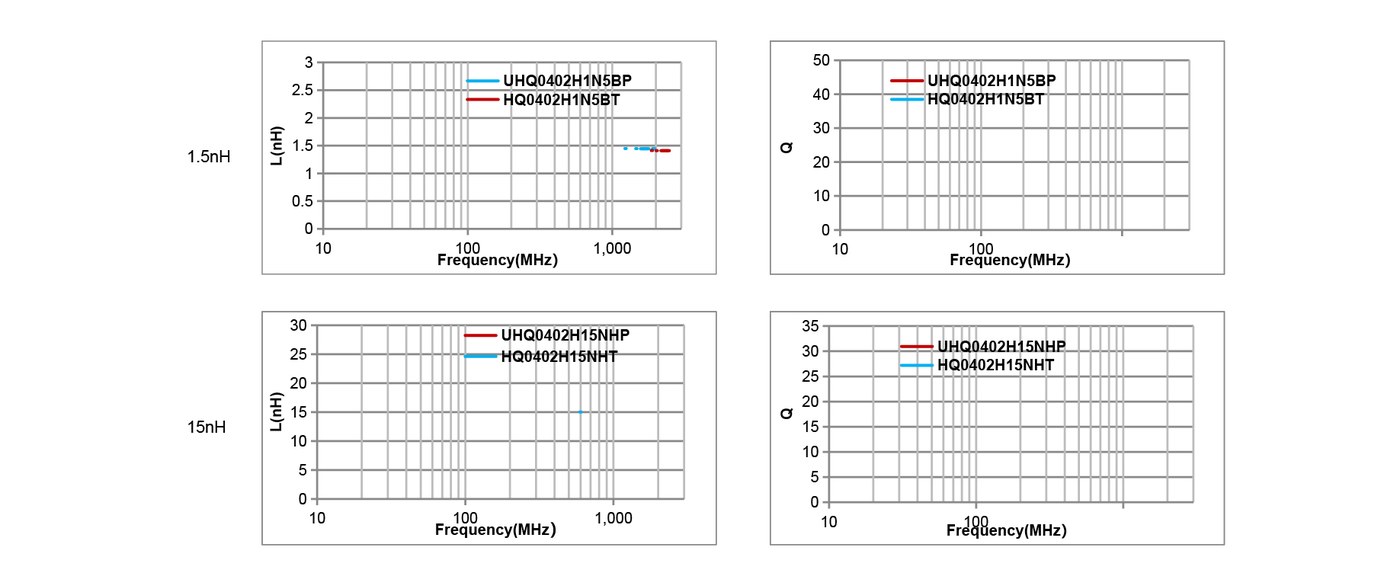
Figure 7: UHQ0402H vs. HQ0402H — inductance and Q-vs-frequency comparison for 1.5 nH and 15 nH values.
5. Power Inductors: The Power Heart of AI Glasses — Wire-Wound SWPA/SPH/WPN/WPG and Beyond
Power inductors sit at the center of every power rail: DC-DC conversion, PMIC delivery and high-current transient response all pass through them. Get them right and the glasses run longer, run cooler and stay stable. Sunlord fields three power-inductor platforms: multilayer alloy (MPF), coated wire-wound (SWPA/SPH/WPN/WPG) and molded (MWTC).
- Conversion efficiency: lower inductor loss means longer battery life from the same cell.
- Temperature rise and heat: lower DCR dissipates less heat — temples stay cool and comfortable.
- Transient response: higher current capability prevents voltage droop and reboots when SoC, camera and display spike together.
- Miniaturization: smaller parts enable thinner temples and lighter frames.
- EMI suppression: better core materials keep power noise away from RF and audio paths.
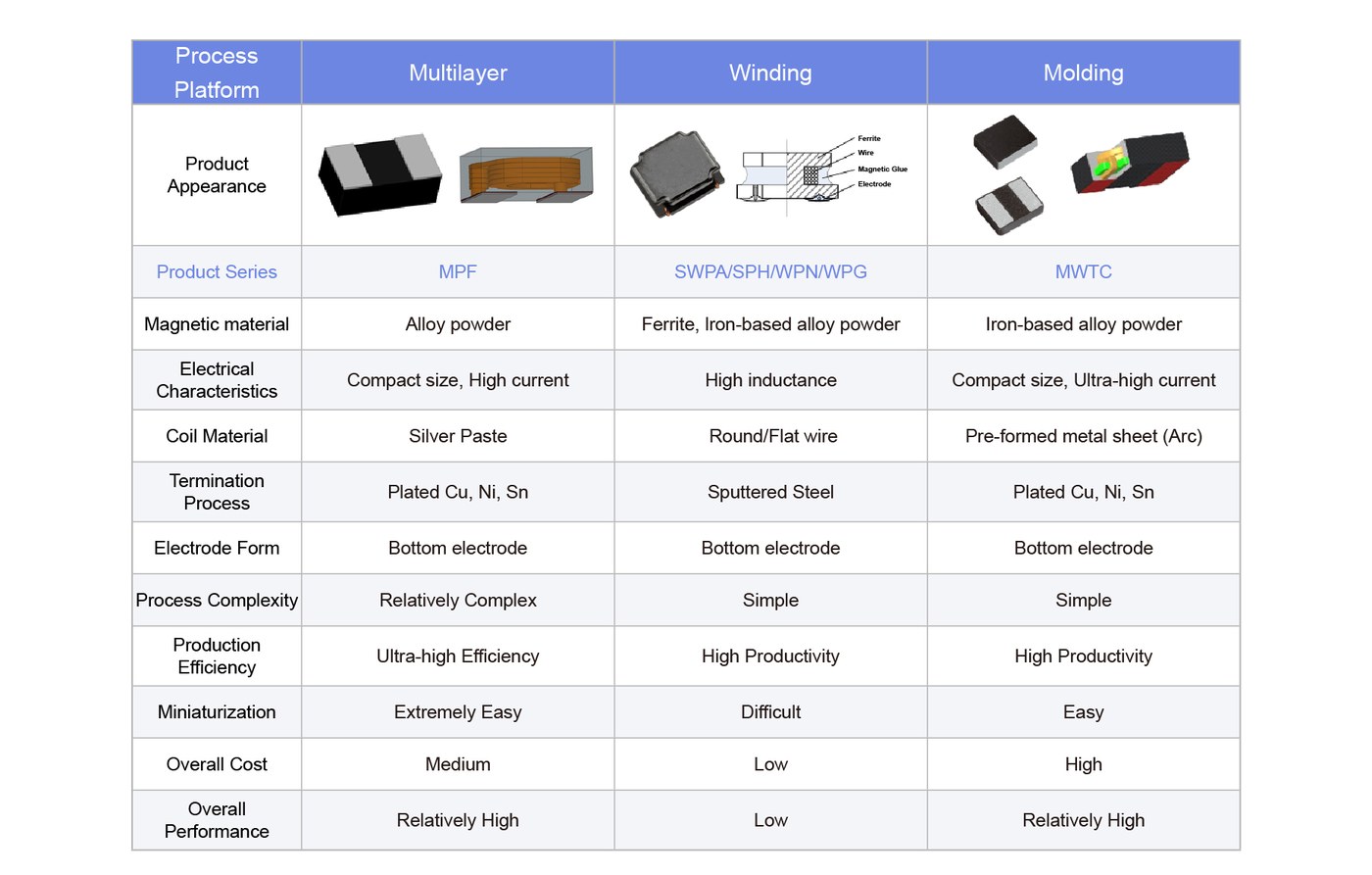
Figure 8: Three platforms, three jobs — MPF multilayer alloy, SWPA/SPH/WPN/WPG coated wire-wound and MWTC molded power inductors compared.
The MWTC molded power inductors are the recommended pick for typical AI glasses circuits. Core technology: T-Core soft magnetic amorphous core + flat enameled copper wire + in-house iron-based alloy magnetic material. Typical part numbers: MWTC160808SR47MT and MWTC1412065SR33MT. Key advantages:
- High current, low DCR: the 0.47 μH version reaches DCR as low as 32 mΩ with Isat up to 5.4 A;
- Power conversion efficiency ≥92% — among the best in its specification class;
- Flat-wire structure: lower internal resistance and faster heat dissipation, with temperature rise 3–5 °C lower than comparable samples;
- Low ripple: cleaner output voltage, power noise reduced by >20%.
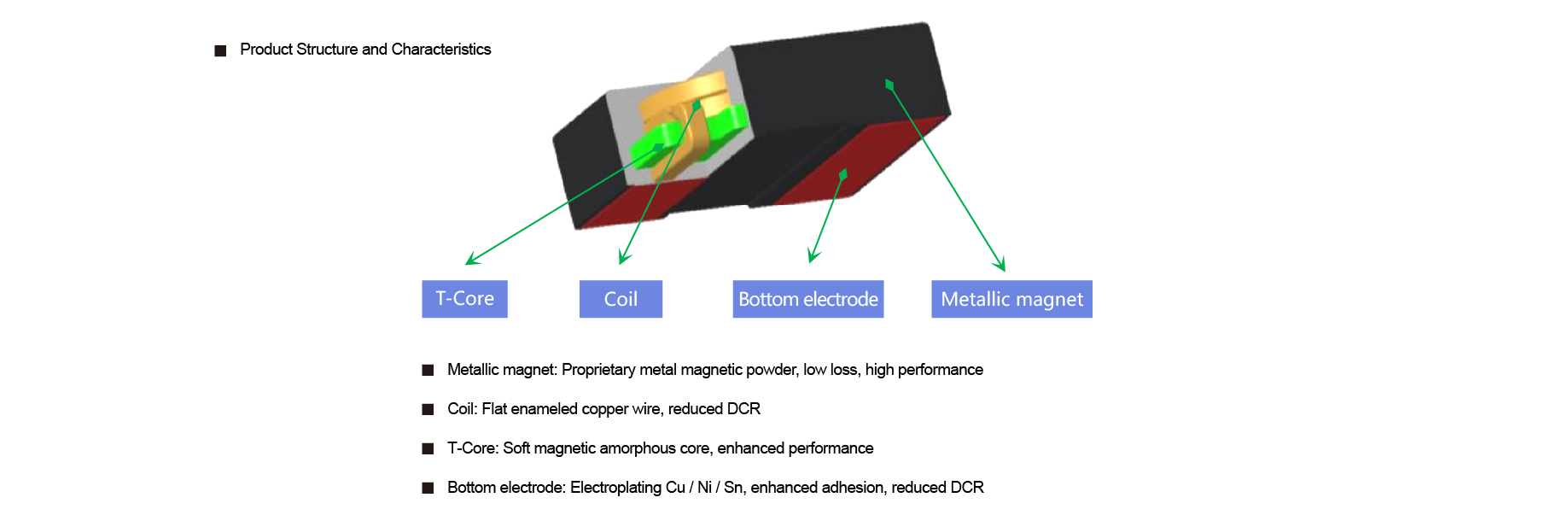
Figure 9: MWTC molded power inductor structure — T-Core amorphous core, flat wire coil and bottom electrodes for low DCR and fast heat spreading.
Where board space is the binding constraint, the MPF multilayer alloy power inductors take over — the compact, low-loss option. Core technology: metal alloy + resin lamination with a high-temperature insulation oxide film. Typical part numbers: MPF1412065SR33MT and MPF1412065SR47MT. Key advantages:
- Ultra-small: down to 1.0 × 0.5 mm — fits AI glasses PMIC rails and frees temple space;
- Ultra-low AC loss: ACR only 0.23 Ω @ 5 MHz (MPF1412065SR33MT), light-load efficiency 6%–10% higher than same-size molded parts;
- Low core loss: heat treatment relieves stress and cuts loss by about 15% — cooler in summer and during sports;
- High thermal conductivity: no organic residues, conductivity improved by >20%, better temperature-rise current;
- High reliability: high-temperature oxide film, performance drift <2% after 1000-hour aging.
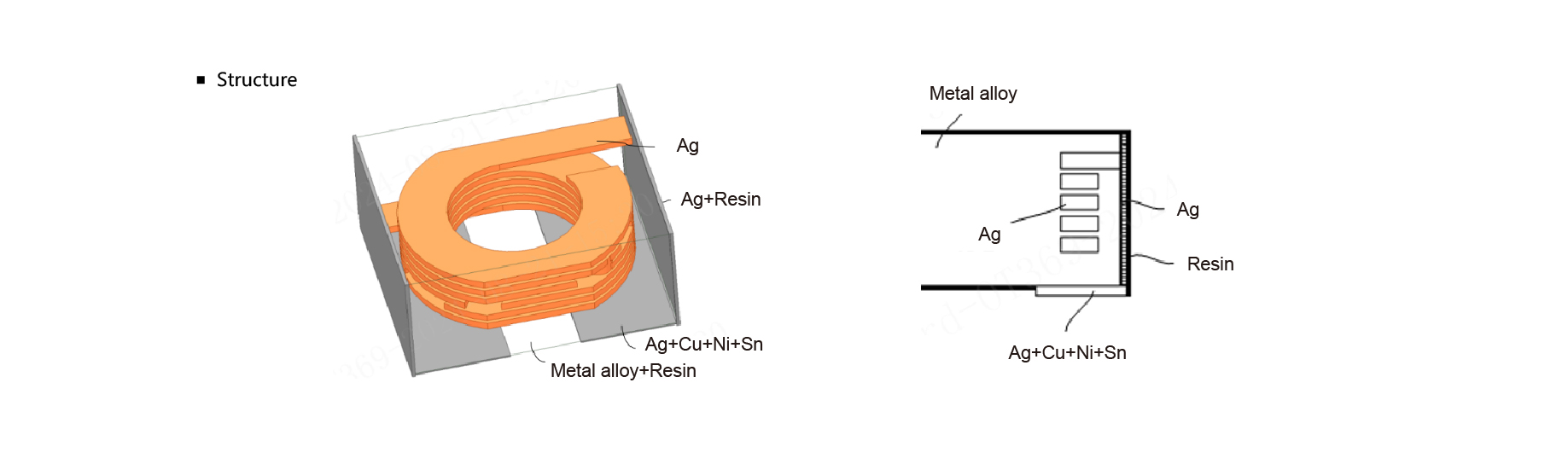

Figure 10: MPF multilayer alloy power inductors — structure and material system behind the 1.0 × 0.5 mm form factor.
For design teams optimizing the coated wire-wound route — the SWPA/SPH/WPN/WPG families pair ferrite and iron-based alloy powder cores with round or flat enameled copper wire for high inductance at high current, all on a proven mass-production platform. Browse the full inductor catalog to compare the three platforms side by side.
6. EMC Components: Measured SNR Gains for Audio and High-Speed Interfaces
On the noise side, the audio ferrite bead MZA series (e.g. MZAH1005F461-R90TF) targets the interference bands that degrade voice:
- Typical impedance 460 Ω @ 900 MHz and 600 Ω @ 1.7 GHz;
- THD+N < 0.1% — measured voice clarity improvement ≥30%;
- Eliminates GSM, Bluetooth and Wi-Fi band interference, with strong wind-noise and echo suppression.
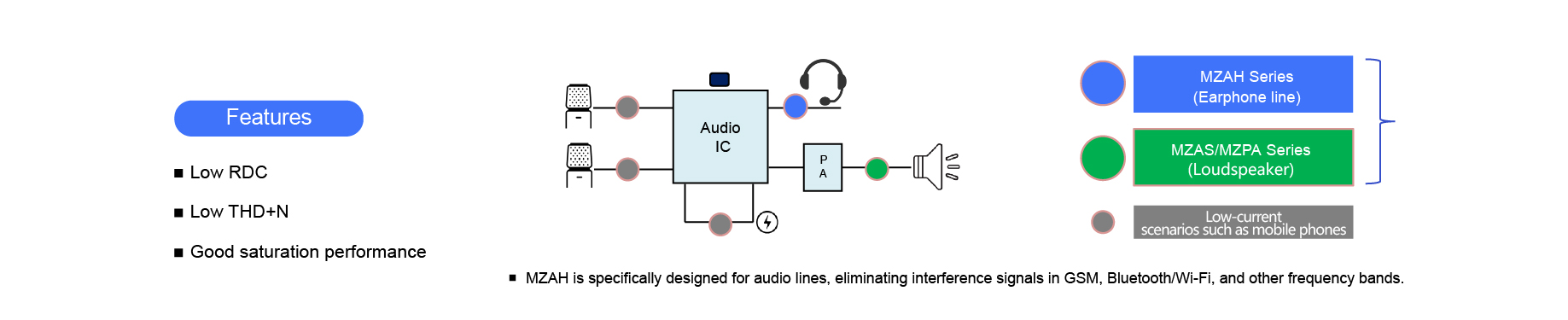

Figure 11: MZA audio ferrite bead solution — dedicated audio-line filtering for headphones, speakers and microphones with low THD+N.
For high-speed interfaces, the common-mode inductor SDMM series delivers broadband common-mode rejection from MHz to GHz, keeping MIPI and USB lanes stable with excellent signal integrity — and resolving MIPI radiation that would otherwise interfere with the antennas, improving camera and display stability.
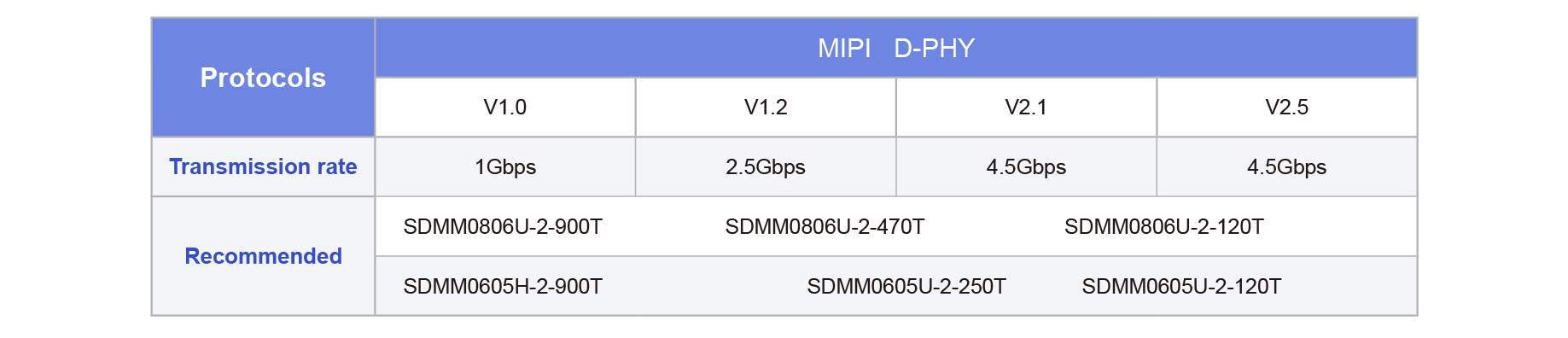

Figure 12: MIPI interface recommendations — SDMM common-mode chokes mapped to D-PHY V1.0–V2.5 and C-PHY V1.0–V2.0 data rates.
Conclusion: One Passive Chain, Four-Way Competitive Edge
AI glasses competition is a four-dimensional race: hardware integration efficiency, power management, industrial design and power stability. Sunlord fights it with measured data, platform certifications and stable mass-production supply, betting its differentiation on transparent antennas + power inductors. From RF to power to signal to antenna, the component solutions above help builders win on slimness, battery life, connectivity, audio-visual quality and looks — as the market scales from millions toward hundreds of millions of units. Explore the Sunlord product lineup to start your AI-glasses BOM review.
Compare power inductor platforms, LTCC filters and EMC components for your next wearable design, or follow product news for new Sunlord releases.
Need Sunlord Components for Your AI-Glasses Design?
●SWPA/SPH/WPN/WPG Wire-Wound Series
●MWTC / MPF Power Inductor Samples
●LTCC + Antenna + EMC Full Chain
●Datasheet & Quotation in 24h
Sunlord Wire-Wound Power Inductors (SWPA/SPH/WPN/WPG): Enabling High-Performance AI Glasses
Time: 2026-09-17 12:06:19
After smartphones and TWS earbuds, AI glasses are shaping up to be the next personal smart-wear entry point. The experience bar — slim form factor, long battery life, stable connectivity and clear audiovisual output — rests almost entirely on upstream passive components: how small they are, how little they lose, how much power they pack and how well they reject interference. YQM ELECTRONICS, as a Sunlord authorized distributor, brings this entire component chain to wearable design teams.
Sunlord Electronics, drawing on years of RF, magnetic materials and precision ceramics expertise, addresses every stage of the AI glasses hardware chain — from the RF front-end through power management to the audio and high-speed signal paths — with five product lines: LTCC RF devices, antennas, RF inductors, power inductors and noise-suppression components. The goal is one chain: smaller, cooler, quieter and longer-lasting glasses.
1. Three Engineering Bottlenecks Every AI-Glasses Design Must Solve
Mainstream AI glasses hardware architectures split into MCU-level, system-level SoC, and SoC+MCU classes. Different compute levels, same three bottlenecks:
- Space constraint: internal volume is extremely tight — components must fit metric 0402/0603 packages wherever possible.
- Power constraint: a small battery must still deliver long endurance, so DCR, ACR and core loss all have to be optimized.
- Signal constraint: Wi-Fi/BT/UWB antennas coexist in one frame, MIPI/USB lanes carry high-speed data, and EMI/EMC budgets are brutally strict.
Sunlord's answer is a full-link portfolio: LTCC RF devices for the front-end, antennas for communication and positioning, RF inductors for matching and sensitivity, power inductors for the DC-DC and PMIC rails, and noise-suppression components to keep every signal clean. Together they unlock on-device AI compute and low-power long-life operation at the passive-component level.
Figure 1: Sunlord AI glasses application architecture — five product lines mapped across the SOC/MCU, camera, display, battery and wireless modules.
2. LTCC RF Devices: Measured Efficiency for Wi-Fi 6E/7 and UWB
For the radio side, Sunlord's LTCC platform delivers two workhorses. The diplexer SLFD15-5R950G-03T covers the Wi-Fi 6E/7 bands:
- Insertion loss: ≤0.65 dB at 2400 MHz, ≤0.95 dB at 5150–7125 MHz;
- Out-of-band rejection: ≥15 dB at 5150–7125 MHz, ≥20 dB at 7200–7500 MHz;
- Power handling: 2.0 W — enough for high-throughput RF front-ends.
Figure 2: SLFD15-5R950G-03T — measured response and electrical specifications for the 2400 MHz and 5150–7125 MHz bands.
For UWB, the bandpass filter SLFB15-7R245G-01TF targets the 6–8 GHz channels:
- Insertion loss: ≤1.3 dB at 6240–6750 MHz, ≤1.0 dB at 7750–8250 MHz;
- Out-of-band rejection: ≥34 dB at 4000–4200 MHz, ≥30 dB at 700–2690 MHz;
- Already mass-produced for premium AR/VR equipment.
Figure 3: SLFB15-7R245G-01TF — UWB bandpass performance and full specification table, proven in AR/VR mass production.
The efficiency difference shows up where wearables live — weak signals, small batteries and crowded bands. Compared with same-class generic parts under identical test conditions, Sunlord's LTCC devices cut insertion loss by roughly 0.2–0.5 dB, which extends communication range by at least 10%–15% at the same transmit power. The higher rejection ratio also suppresses spurious radiation, lifting antenna sensitivity by about 2 dB — the margin that keeps glasses connected indoors and on the move.
3. Antenna Matrix: Conventional Antennas at Scale, Transparent Antennas for Design Freedom
Sunlord covers the complete antenna set for AI glasses — PDS antennas, UWB antennas, NFC antennas, WPC wireless charging coils and the flagship transparent antenna — balancing five requirements at once: communication, positioning, charging, sensing and appearance.
Figure 4: Sunlord AI glasses antenna matrix — from mass-produced PDS, WPC and NFC designs to UWB and transparent antennas.
Traditional AI glasses put antennas in the temples, because lenses and front frames have no room for metal radiators. Sunlord's transparent antenna, developed specifically for AI glasses, integrates directly into lenses, transparent front frames or see-through frame areas — invisible looks, unobstructed vision, undiminished communication. It supports the five high-value scenarios of AI eyewear: target recognition, perceptual communication, precise navigation, intelligent control and contactless payment.
Figure 5: Sunlord transparent antenna — mounted on lenses and front frames, freeing temple space for thinner, lighter glasses.
Structure and electrical performance:
- Sheet resistance: typical 0.35 Ω/□ — low loss, high transmission efficiency;
- Frequency coverage: full Wi-Fi/BT/UWB bands;
- Communication efficiency: no lower than conventional LDS/PDS antennas;
- Dimensions: typical 153 mm × 219 mm, custom-cut to fit;
- Process: thin-film groove wiring — no metal obstruction, bend-resistant, highly reliable.
The transparent material does not block vision or design aesthetics, and suits sunglasses, optical glasses and AR form factors alike. Mounting on lenses and front frames releases the temple volume for slimmer profiles; combined with temple antennas it forms a diversity pair that improves measured signal stability by 20% in motion and indoor scenarios. With mature processes in small-batch trial production, it is ready for fast integration into terminal mass production.
4. RF Inductors: High Q Buys Receiver Sensitivity
On the matching network side, Sunlord's high-Q multilayer HQ/UHQ series pushes the Q envelope: the UHQ series delivers a typical Q > 30 @ 1 GHz for 1.5 nH — standout performance in its class — with lower parasitic capacitance and a higher self-resonant frequency (SRF) than conventional parts.
Figure 6: Sunlord HQ series multilayer RF inductors — vertical coil and L-type electrode design cuts parasitic capacitance and lifts Q.
The wire-wound MWSD-C series adds another lever for matching precision: at the same inductance, Q measures 8%–12% higher than comparable competitor samples. In efficiency terms, RF link loss drops by 0.3–0.8 dB and receiver sensitivity rises accordingly, while the metric 0603 footprint saves roughly 40% of board area — space that goes straight back into the temple design.
Figure 7: UHQ0402H vs. HQ0402H — inductance and Q-vs-frequency comparison for 1.5 nH and 15 nH values.
5. Power Inductors: The Power Heart of AI Glasses — Wire-Wound SWPA/SPH/WPN/WPG and Beyond
Power inductors sit at the center of every power rail: DC-DC conversion, PMIC delivery and high-current transient response all pass through them. Get them right and the glasses run longer, run cooler and stay stable. Sunlord fields three power-inductor platforms: multilayer alloy (MPF), coated wire-wound (SWPA/SPH/WPN/WPG) and molded (MWTC).
- Conversion efficiency: lower inductor loss means longer battery life from the same cell.
- Temperature rise and heat: lower DCR dissipates less heat — temples stay cool and comfortable.
- Transient response: higher current capability prevents voltage droop and reboots when SoC, camera and display spike together.
- Miniaturization: smaller parts enable thinner temples and lighter frames.
- EMI suppression: better core materials keep power noise away from RF and audio paths.
Figure 8: Three platforms, three jobs — MPF multilayer alloy, SWPA/SPH/WPN/WPG coated wire-wound and MWTC molded power inductors compared.
The MWTC molded power inductors are the recommended pick for typical AI glasses circuits. Core technology: T-Core soft magnetic amorphous core + flat enameled copper wire + in-house iron-based alloy magnetic material. Typical part numbers: MWTC160808SR47MT and MWTC1412065SR33MT. Key advantages:
- High current, low DCR: the 0.47 μH version reaches DCR as low as 32 mΩ with Isat up to 5.4 A;
- Power conversion efficiency ≥92% — among the best in its specification class;
- Flat-wire structure: lower internal resistance and faster heat dissipation, with temperature rise 3–5 °C lower than comparable samples;
- Low ripple: cleaner output voltage, power noise reduced by >20%.
Figure 9: MWTC molded power inductor structure — T-Core amorphous core, flat wire coil and bottom electrodes for low DCR and fast heat spreading.
Where board space is the binding constraint, the MPF multilayer alloy power inductors take over — the compact, low-loss option. Core technology: metal alloy + resin lamination with a high-temperature insulation oxide film. Typical part numbers: MPF1412065SR33MT and MPF1412065SR47MT. Key advantages:
- Ultra-small: down to 1.0 × 0.5 mm — fits AI glasses PMIC rails and frees temple space;
- Ultra-low AC loss: ACR only 0.23 Ω @ 5 MHz (MPF1412065SR33MT), light-load efficiency 6%–10% higher than same-size molded parts;
- Low core loss: heat treatment relieves stress and cuts loss by about 15% — cooler in summer and during sports;
- High thermal conductivity: no organic residues, conductivity improved by >20%, better temperature-rise current;
- High reliability: high-temperature oxide film, performance drift <2% after 1000-hour aging.
Figure 10: MPF multilayer alloy power inductors — structure and material system behind the 1.0 × 0.5 mm form factor.
For design teams optimizing the coated wire-wound route — the SWPA/SPH/WPN/WPG families pair ferrite and iron-based alloy powder cores with round or flat enameled copper wire for high inductance at high current, all on a proven mass-production platform. Browse the full inductor catalog to compare the three platforms side by side.
6. EMC Components: Measured SNR Gains for Audio and High-Speed Interfaces
On the noise side, the audio ferrite bead MZA series (e.g. MZAH1005F461-R90TF) targets the interference bands that degrade voice:
- Typical impedance 460 Ω @ 900 MHz and 600 Ω @ 1.7 GHz;
- THD+N < 0.1% — measured voice clarity improvement ≥30%;
- Eliminates GSM, Bluetooth and Wi-Fi band interference, with strong wind-noise and echo suppression.
Figure 11: MZA audio ferrite bead solution — dedicated audio-line filtering for headphones, speakers and microphones with low THD+N.
For high-speed interfaces, the common-mode inductor SDMM series delivers broadband common-mode rejection from MHz to GHz, keeping MIPI and USB lanes stable with excellent signal integrity — and resolving MIPI radiation that would otherwise interfere with the antennas, improving camera and display stability.
Figure 12: MIPI interface recommendations — SDMM common-mode chokes mapped to D-PHY V1.0–V2.5 and C-PHY V1.0–V2.0 data rates.
Conclusion: One Passive Chain, Four-Way Competitive Edge
AI glasses competition is a four-dimensional race: hardware integration efficiency, power management, industrial design and power stability. Sunlord fights it with measured data, platform certifications and stable mass-production supply, betting its differentiation on transparent antennas + power inductors. From RF to power to signal to antenna, the component solutions above help builders win on slimness, battery life, connectivity, audio-visual quality and looks — as the market scales from millions toward hundreds of millions of units. Explore the Sunlord product lineup to start your AI-glasses BOM review.
Compare power inductor platforms, LTCC filters and EMC components for your next wearable design, or follow product news for new Sunlord releases.
Need Sunlord Components for Your AI-Glasses Design?
●SWPA/SPH/WPN/WPG Wire-Wound Series
●MWTC / MPF Power Inductor Samples
●LTCC + Antenna + EMC Full Chain
●Datasheet & Quotation in 24h
Other Articles
-

Role of 32.768 kHz in Circuit Design
-
SiTime Automotive Oscillators
-
The Role of 32.768kHz in Circuits
-
Epson RTC modules solve three major pain points of ioT
-
11.0592MHz Crystal Oscillator: The "Heart" of the Computer Motherboard?
-
Examine the cost and design considerations of crystals and oscillators
-
Exploring how YXC oscillators show their skills to help with AI servers
-
Lessons from the Middle East Events — The Importance of Localization!
-
Good News: YQM won Epson's 2023 New Market Development Award !!!
-
YXC Active Differential Programmable Crystal Oscillator Supports 5G Base Station Applications


Copyright By © YQM ELECTRONICS INTL LIMITED SITEMAP
Email: sales@yqmec.com

点击右上角
分享给朋友吧


