
YXC YSO233UJ Ultra-Low-Jitter XO: 30fs @ 312.5MHz in 2.0×1.6mm
Time: 2026-09-21 11:03:20
Inside a 400G optical module or a 25.6T data-center switch, the reference clock is not a background component — it is the metronome every SerDes lane obeys. When jitter rises, the eye diagram closes, the bit-error rate (BER) climbs, and link margin that took months to qualify disappears in decibels. YXC Yangxing Technology's YSO233UJ ultra-low-jitter differential oscillator — distributed by YQM ELECTRONICS — was engineered for exactly these designs: 30fs typical jitter at 312.5MHz, a 2.0mm × 1.6mm package, and ±20ppm frequency stability from -40℃ to +105℃.
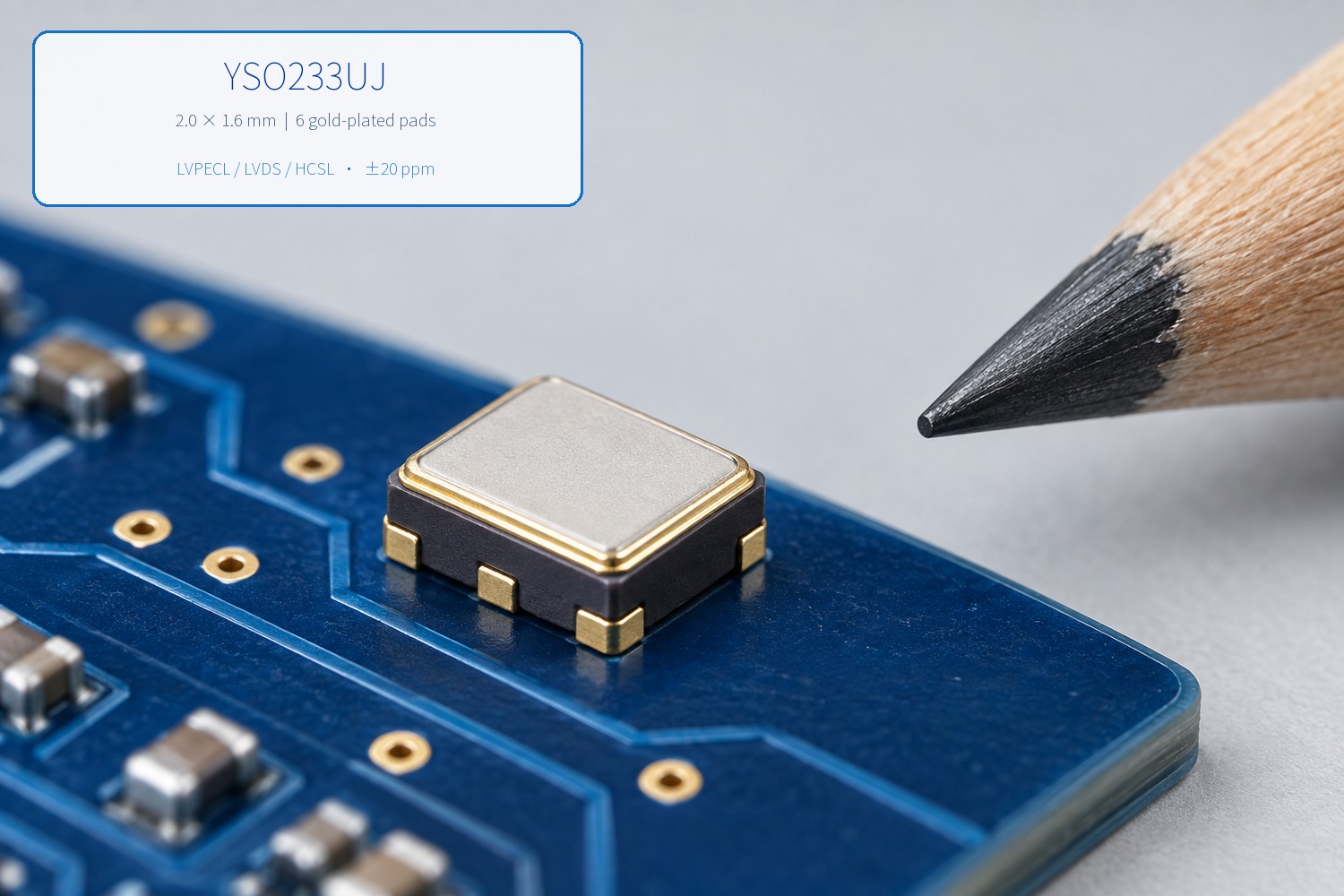
Figure 1: YSO233UJ ultra-low-jitter differential oscillator — 2.0×1.6mm package with LVPECL/LVDS/HCSL differential outputs.
1. Why Jitter Is the Currency of High-Speed Signal Integrity
1.1 Jitter Directly Eats the Eye Margin
Every high-speed serial standard — PCIe, SATA, USB 3.0, 10G/25G/100G Ethernet — specifies a timing budget for its transmit path. The reference clock's jitter is subtracted from that budget before the link even leaves the package. With 30fs (0.03ps) typical jitter, the YSO233UJ leaves nearly the entire budget intact for the PLL, the transmitter and the channel, keeping the eye diagram wide open and the BER low.
1.2 The Reference Clock Sets the Floor for SerDes Performance
A SerDes PLL can only be as clean as the clock it locks to. Multiplying a noisy fundamental pushes phase noise up by 20·log(N), so a poor reference costs more and more as data rates climb to 25G, 50G and 100G per lane. The YSO233UJ attacks this at the source — see Section 3.4 — rather than filtering the damage downstream.
2. YSO233UJ: Ultra-Low-Jitter Differential XO at a Glance
According to YXC's technical specifications, the YSO233UJ's key parameters are:
| Parameter | YSO233UJ Specification |
|---|---|
| Product Type | Ultra-low-jitter differential oscillator (XO) |
| Output Type | Differential: LVPECL / LVDS / HCSL (selectable) |
| Supported Frequencies | 100 / 125 / 156.25 / 200 / 212.5 / 312.5 MHz |
| Package Size | 2.0mm × 1.6mm |
| Jitter Performance | 30fs @ 312.5MHz (typical) |
| Frequency Stability | ±20ppm (-40℃ ~ +105℃) |
| Core Technology | Lithographic high-frequency fundamental |
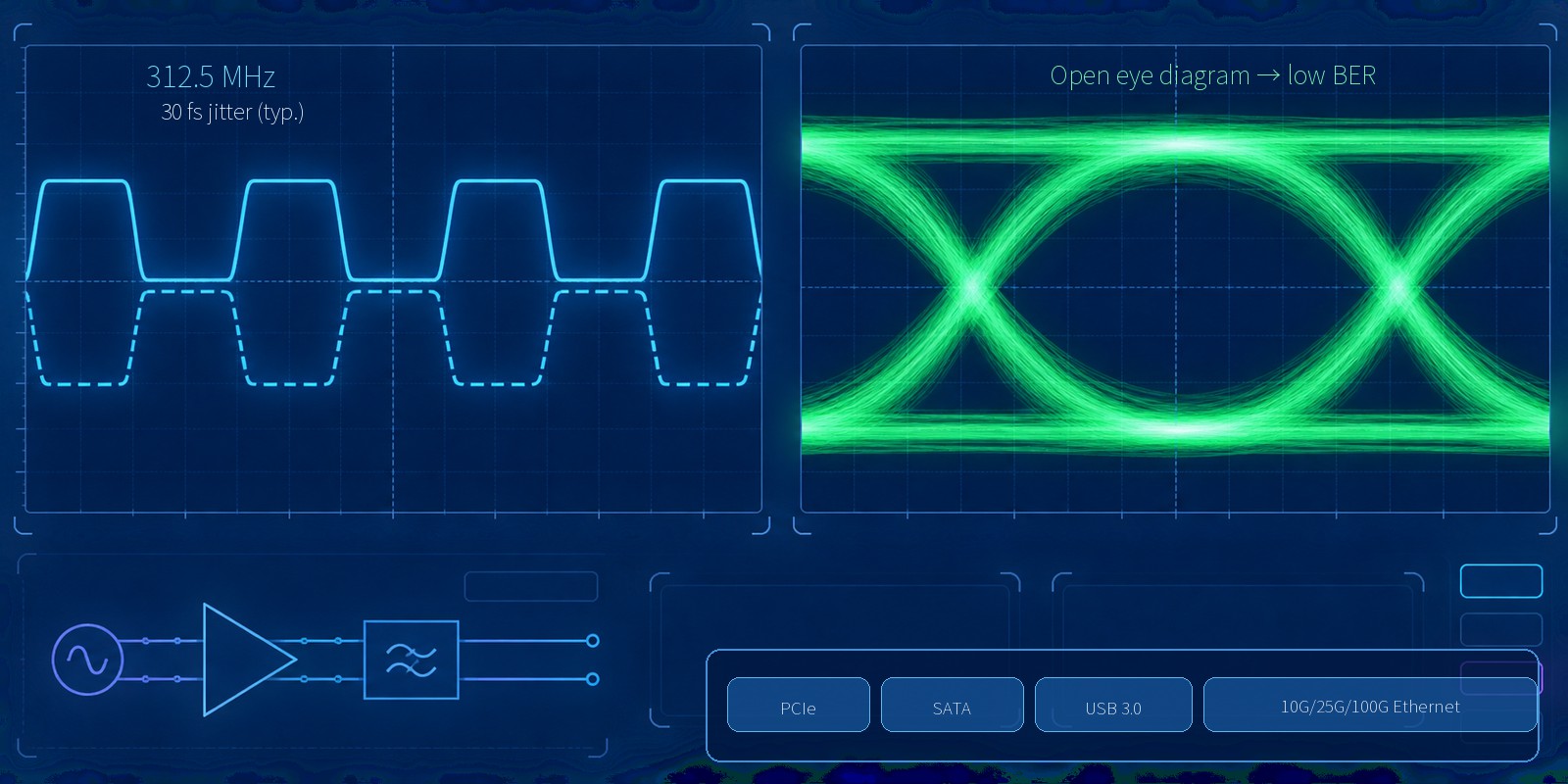
Figure 2: 30fs typical jitter at 312.5MHz — the YSO233UJ keeps the eye diagram open for high-speed SerDes links.
3. Four Engineering Highlights
3.1 30fs @ 312.5MHz — a Near-Ideal Reference Clock
At 312.5MHz, typical jitter is just 30 femtoseconds. For high-speed serial links — PCIe, SATA, USB 3.0, 10G/25G/100G Ethernet — this level of purity translates directly into eye margin and a measurably lower BER, letting your system meet compliance with headroom instead of borderline pass.
3.2 2.0mm × 1.6mm — the Smallest Envelope for Dense Boards
Modern designs demand every square millimetre of PCB. The YSO233UJ's ultra-compact package slips easily into optical modules, SSDs and high-end FPGA/ASIC boards where traditional 3225 or 5032 oscillators simply do not fit.
3.3 ±20ppm Across -40℃ ~ +105℃ — Stability the Whole Temperature Range
Whether the equipment sits in an air-conditioned data hall or an outdoor 5G enclosure, the YSO233UJ holds ±20ppm frequency stability over the full industrial temperature range — a consistent, dependable clock for long-term field operation.
3.4 Lithographic High-Frequency Fundamental + Three Output Formats
YXC's lithographic high-frequency fundamental technology generates the target frequency directly at the source, eliminating the phase-noise accumulation of PLL frequency multiplication. Combined with LVPECL / LVDS / HCSL selectable differential outputs, the YSO233UJ adapts to backplanes, optics and PCIe clocking without signal-conversion overhead.
4. Target Applications
- 100G/400G optical modules: reference clock source for high-speed transceivers
- Data-center switches & routers: high-speed backplane SerDes clocking
- 5G base stations: fronthaul / midhaul link synchronization
- Test & measurement instruments: low-phase-noise reference source
- NVMe SSDs: high-frequency clock for NVMe controllers
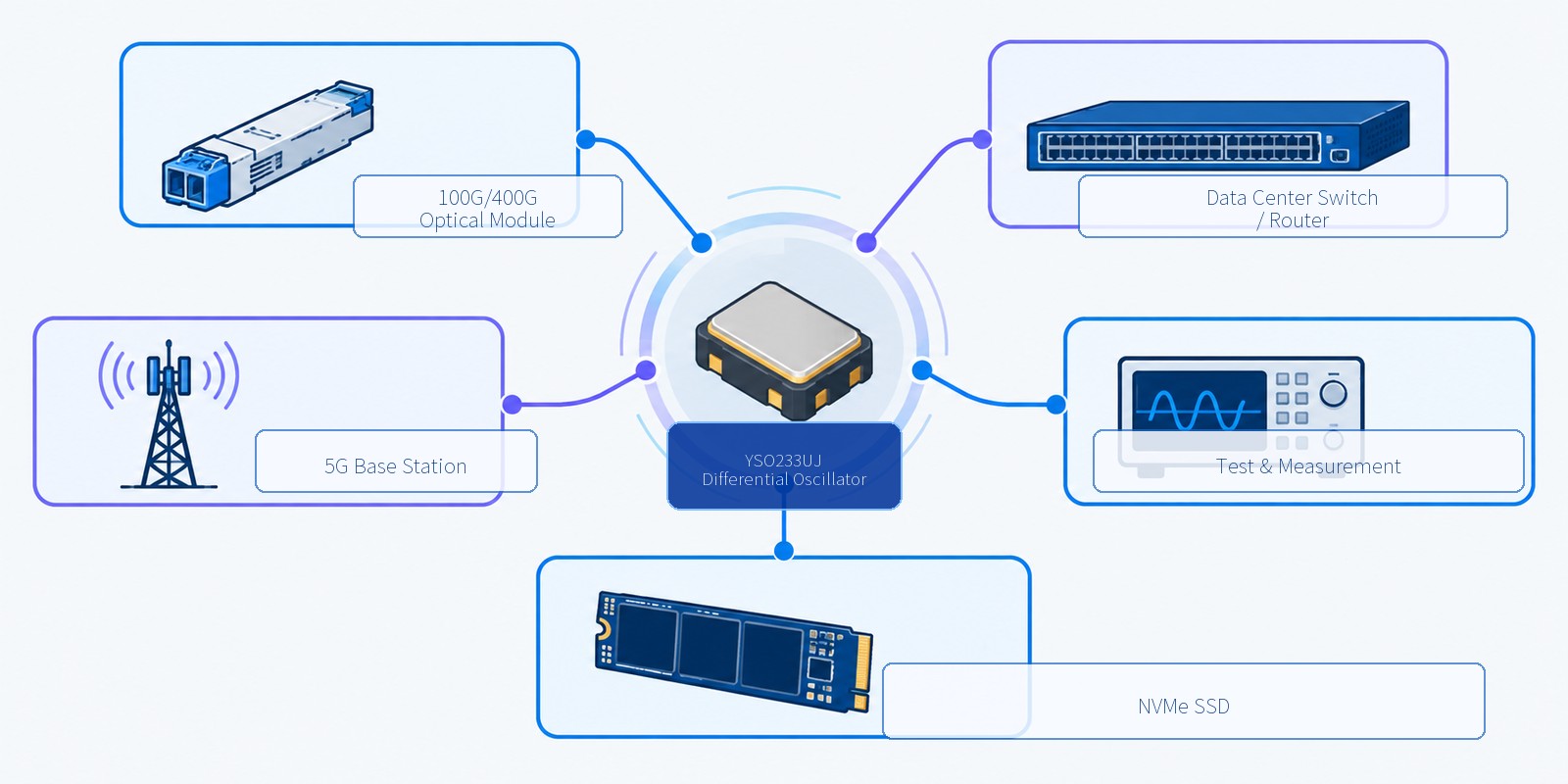
Figure 3: From 100G/400G optical modules to 5G base stations — the YSO233UJ application map.
5. FAQ: YSO233UJ in High-Speed Designs
Q1: What does 30fs jitter actually buy me in a real design?
A1: 30fs equals 0.03ps — for perspective, light travels only about 9µm in that time. As a reference clock, this level of jitter consumes almost none of a link's timing budget, so the eye margin your SerDes, PLL and channel need stays intact, which shows up as lower BER and easier compliance.
Q2: Which output format should I choose — LVPECL, LVDS or HCSL?
A2: LVPECL suits long backplane traces with high fan-out, LVDS offers balanced low-power differential signaling for optics and storage, and HCSL is the natural choice for PCIe reference clocking. The YSO233UJ supports all three, selectable at order time — one part, three interface strategies.
Q3: Is the YSO233UJ suitable for 400G optical modules?
A3: Yes. Its supported frequencies include 156.25MHz and 312.5MHz — the reference frequencies used across 400G optical ecosystems — while the 2.0mm × 1.6mm package fits the tight space budgets of QSFP-DD / OSFP form factors. ±20ppm over -40℃ ~ +105℃ keeps the module compliant across its full operating range.
Conclusion: When Jitter Equals Performance, Start with the Clock
In the age of 400G optics and 5G infrastructure, the reference clock is no longer a commodity — it is a performance component. The YXC YSO233UJ pairs 30fs ultra-low jitter with a 2.0mm × 1.6mm package and ±20ppm wide-temperature stability, giving clock-tree designers a dependable cornerstone for the next generation of high-speed systems. Browse the differential oscillator portfolio and the low-jitter oscillator category to place the YSO233UJ in your clock tree — or explore the full oscillator range distributed by YQM ELECTRONICS.
Need YSO233UJ Samples or a Clock-Tree Design Review?
●YSO233UJ Samples In Stock
●LVPECL / LVDS / HCSL Portfolio
●Free FAE Clock-Tree Review
●Fast Datasheet & Quotation
YXC YSO233UJ Ultra-Low-Jitter XO: 30fs @ 312.5MHz in 2.0×1.6mm
Time: 2026-09-21 11:03:20
Inside a 400G optical module or a 25.6T data-center switch, the reference clock is not a background component — it is the metronome every SerDes lane obeys. When jitter rises, the eye diagram closes, the bit-error rate (BER) climbs, and link margin that took months to qualify disappears in decibels. YXC Yangxing Technology's YSO233UJ ultra-low-jitter differential oscillator — distributed by YQM ELECTRONICS — was engineered for exactly these designs: 30fs typical jitter at 312.5MHz, a 2.0mm × 1.6mm package, and ±20ppm frequency stability from -40℃ to +105℃.
Figure 1: YSO233UJ ultra-low-jitter differential oscillator — 2.0×1.6mm package with LVPECL/LVDS/HCSL differential outputs.
1. Why Jitter Is the Currency of High-Speed Signal Integrity
1.1 Jitter Directly Eats the Eye Margin
Every high-speed serial standard — PCIe, SATA, USB 3.0, 10G/25G/100G Ethernet — specifies a timing budget for its transmit path. The reference clock's jitter is subtracted from that budget before the link even leaves the package. With 30fs (0.03ps) typical jitter, the YSO233UJ leaves nearly the entire budget intact for the PLL, the transmitter and the channel, keeping the eye diagram wide open and the BER low.
1.2 The Reference Clock Sets the Floor for SerDes Performance
A SerDes PLL can only be as clean as the clock it locks to. Multiplying a noisy fundamental pushes phase noise up by 20·log(N), so a poor reference costs more and more as data rates climb to 25G, 50G and 100G per lane. The YSO233UJ attacks this at the source — see Section 3.4 — rather than filtering the damage downstream.
2. YSO233UJ: Ultra-Low-Jitter Differential XO at a Glance
According to YXC's technical specifications, the YSO233UJ's key parameters are:
| Parameter | YSO233UJ Specification |
|---|---|
| Product Type | Ultra-low-jitter differential oscillator (XO) |
| Output Type | Differential: LVPECL / LVDS / HCSL (selectable) |
| Supported Frequencies | 100 / 125 / 156.25 / 200 / 212.5 / 312.5 MHz |
| Package Size | 2.0mm × 1.6mm |
| Jitter Performance | 30fs @ 312.5MHz (typical) |
| Frequency Stability | ±20ppm (-40℃ ~ +105℃) |
| Core Technology | Lithographic high-frequency fundamental |
Figure 2: 30fs typical jitter at 312.5MHz — the YSO233UJ keeps the eye diagram open for high-speed SerDes links.
3. Four Engineering Highlights
3.1 30fs @ 312.5MHz — a Near-Ideal Reference Clock
At 312.5MHz, typical jitter is just 30 femtoseconds. For high-speed serial links — PCIe, SATA, USB 3.0, 10G/25G/100G Ethernet — this level of purity translates directly into eye margin and a measurably lower BER, letting your system meet compliance with headroom instead of borderline pass.
3.2 2.0mm × 1.6mm — the Smallest Envelope for Dense Boards
Modern designs demand every square millimetre of PCB. The YSO233UJ's ultra-compact package slips easily into optical modules, SSDs and high-end FPGA/ASIC boards where traditional 3225 or 5032 oscillators simply do not fit.
3.3 ±20ppm Across -40℃ ~ +105℃ — Stability the Whole Temperature Range
Whether the equipment sits in an air-conditioned data hall or an outdoor 5G enclosure, the YSO233UJ holds ±20ppm frequency stability over the full industrial temperature range — a consistent, dependable clock for long-term field operation.
3.4 Lithographic High-Frequency Fundamental + Three Output Formats
YXC's lithographic high-frequency fundamental technology generates the target frequency directly at the source, eliminating the phase-noise accumulation of PLL frequency multiplication. Combined with LVPECL / LVDS / HCSL selectable differential outputs, the YSO233UJ adapts to backplanes, optics and PCIe clocking without signal-conversion overhead.
4. Target Applications
- 100G/400G optical modules: reference clock source for high-speed transceivers
- Data-center switches & routers: high-speed backplane SerDes clocking
- 5G base stations: fronthaul / midhaul link synchronization
- Test & measurement instruments: low-phase-noise reference source
- NVMe SSDs: high-frequency clock for NVMe controllers
Figure 3: From 100G/400G optical modules to 5G base stations — the YSO233UJ application map.
5. FAQ: YSO233UJ in High-Speed Designs
Q1: What does 30fs jitter actually buy me in a real design?
A1: 30fs equals 0.03ps — for perspective, light travels only about 9µm in that time. As a reference clock, this level of jitter consumes almost none of a link's timing budget, so the eye margin your SerDes, PLL and channel need stays intact, which shows up as lower BER and easier compliance.
Q2: Which output format should I choose — LVPECL, LVDS or HCSL?
A2: LVPECL suits long backplane traces with high fan-out, LVDS offers balanced low-power differential signaling for optics and storage, and HCSL is the natural choice for PCIe reference clocking. The YSO233UJ supports all three, selectable at order time — one part, three interface strategies.
Q3: Is the YSO233UJ suitable for 400G optical modules?
A3: Yes. Its supported frequencies include 156.25MHz and 312.5MHz — the reference frequencies used across 400G optical ecosystems — while the 2.0mm × 1.6mm package fits the tight space budgets of QSFP-DD / OSFP form factors. ±20ppm over -40℃ ~ +105℃ keeps the module compliant across its full operating range.
Conclusion: When Jitter Equals Performance, Start with the Clock
In the age of 400G optics and 5G infrastructure, the reference clock is no longer a commodity — it is a performance component. The YXC YSO233UJ pairs 30fs ultra-low jitter with a 2.0mm × 1.6mm package and ±20ppm wide-temperature stability, giving clock-tree designers a dependable cornerstone for the next generation of high-speed systems. Browse the differential oscillator portfolio and the low-jitter oscillator category to place the YSO233UJ in your clock tree — or explore the full oscillator range distributed by YQM ELECTRONICS.
Need YSO233UJ Samples or a Clock-Tree Design Review?
●YSO233UJ Samples In Stock
●LVPECL / LVDS / HCSL Portfolio
●Free FAE Clock-Tree Review
●Fast Datasheet & Quotation
Other Articles
-

Role of 32.768 kHz in Circuit Design
-
SiTime Automotive Oscillators
-
The Role of 32.768kHz in Circuits
-
11.0592MHz Crystal Oscillator: The "Heart" of the Computer Motherboard?
-
Epson RTC modules solve three major pain points of ioT
-
Examine the cost and design considerations of crystals and oscillators
-
Exploring how YXC oscillators show their skills to help with AI servers
-
Lessons from the Middle East Events — The Importance of Localization!
-
Good News: YQM won Epson's 2023 New Market Development Award !!!
-
YXC Active Differential Programmable Crystal Oscillator Supports 5G Base Station Applications


Copyright By © YQM ELECTRONICS INTL LIMITED SITEMAP
Email: sales@yqmec.com

点击右上角
分享给朋友吧


