
SiT9375: 150 fs RMS Ultra-Low Jitter Differential MEMS Oscillator with Industry's Smallest 2.0×1.6 mm Package
Time: 2026-07-31 15:56:59
Breaking the High-Speed Clock Barrier: SiT9375 Redefines Industry Standards with 150 fs Jitter and the Industry's Smallest Differential Package
As 5G communications, hyperscale data centers, and AI/ML compute clusters continue their exponential growth trajectory, modern electronic systems are navigating an unprecedented data deluge. In high-speed data links — from 100G to 400G Ethernet and beyond to emerging 800G standards — the system clock serves as the heartbeat of the entire signal chain. Clock signal integrity directly governs bit error rate (BER), eye diagram margin, and overall system stability. However, the communications industry now faces a compounding dual challenge: relentless pressure to reduce timing jitter below sub-200-femtosecond thresholds while simultaneously shrinking PCB footprints in increasingly dense hardware deployments.
Traditional quartz-based differential oscillators — constrained by fundamental mechanical resonator physics — are approaching their performance ceiling in both jitter floor and minimum package geometry. The industry has been waiting for a technology platform that can break through both barriers simultaneously. SiTime's SiT9375 differential MEMS oscillator delivers precisely that breakthrough, combining 150 fs RMS typical phase jitter with 2.0×1.6 mm package dimensions — the smallest differential oscillator footprint available on the market today.
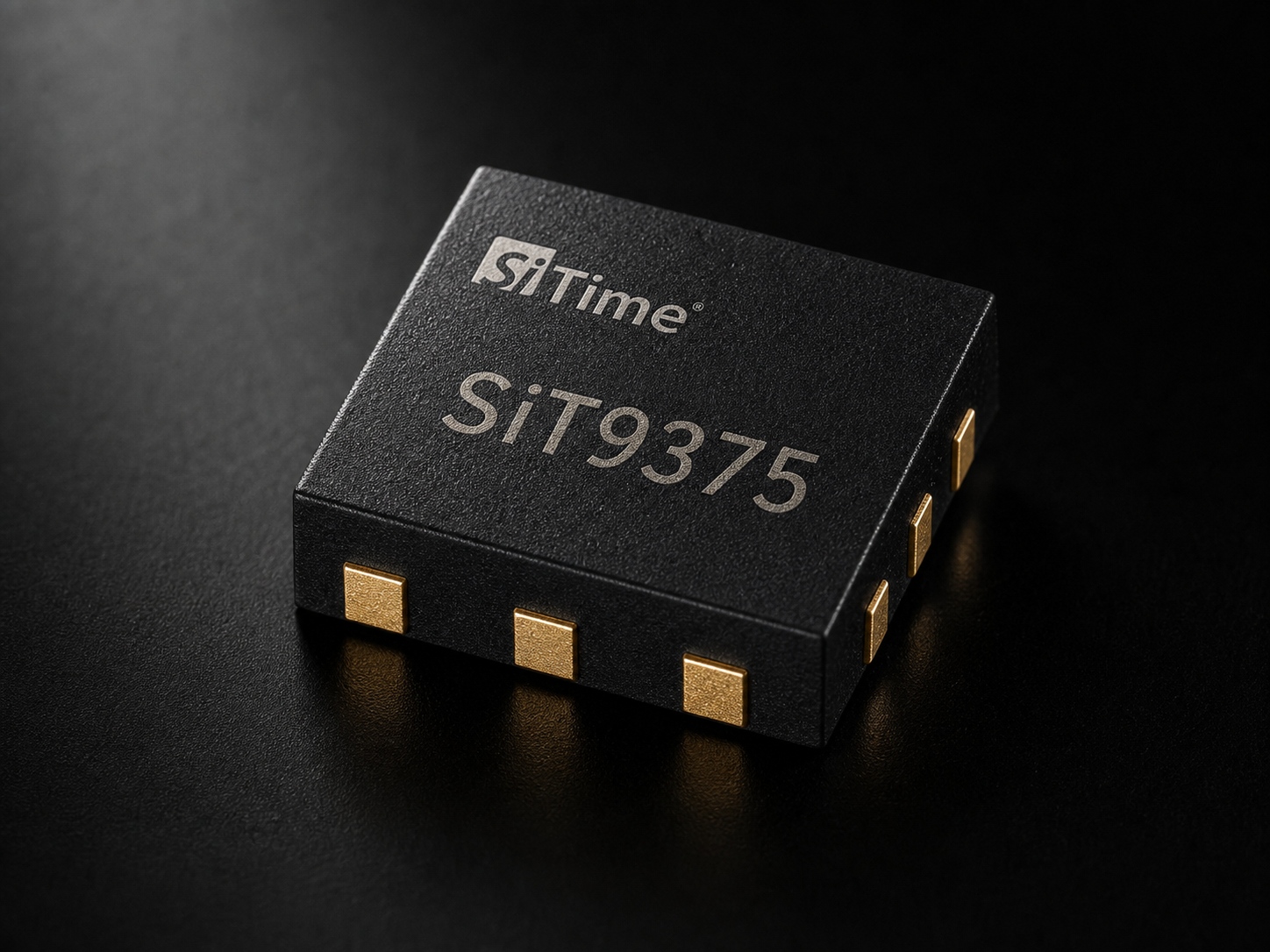
Figure 1: SiTime SiT9375 — 150 fs RMS ultra-low jitter differential MEMS oscillator in 2.0×1.6 mm QFN package.
SiT9375 Product Overview: Purpose-Built for the Communications Era
The SiT9375 is a high-performance differential MEMS oscillator engineered by SiTime to address the most demanding requirements of modern communications infrastructure. Spanning 34 standard frequencies from 25 MHz to 644.53125 MHz, the SiT9375 eliminates the mechanical resonator limitations inherent in quartz crystal oscillators, delivering MEMS-based reliability with quartz-beating phase noise performance. Whether deployed as a reference clock for high-speed network routers and switches, SerDes transceivers, or as a precision clock source for FPGA and DDR4/DDR5 memory subsystems, the SiT9375 delivers best-in-class jitter performance without compromising on board space.
SiT9375 Technical Specifications At a Glance
The SiT9375 achieves industry-leading performance across every critical parameter for high-speed clocking applications:
| Parameter | Specification |
|---|---|
| Oscillator Type | Differential MEMS Oscillator (XO-DE) |
| Frequency Range | 25 MHz ~ 644.53125 MHz (34 standard frequencies) |
| Phase Jitter | 150 fs RMS (typical, 12 kHz ~ 20 MHz integration bandwidth) |
| Frequency Stability | ±20 ppm, ±25 ppm, ±30 ppm, ±50 ppm |
| Output Types | LVPECL, LVDS, HCSL, Low-Power HCSL, FlexSwing™ |
| Operating Temperature | -40°C to +105°C |
| Supply Voltage | 1.8V, 2.5V, 3.3V, 1.71–3.63V, 2.25–3.63V |
| Package Dimensions | 2.0×1.6 mm, 2.5×2.0 mm, 3.2×2.5 mm |
| PSNR (Power Supply Noise Rejection) | 9 fs/mV (typical) |
| Vibration Sensitivity | 20× better than quartz crystal oscillators |
Six Technology Differentiators That Set the SiT9375 Apart
The SiT9375's market leadership position is built on architectural and process innovations that address the root causes of timing degradation in real-world system environments:
1. 150 fs RMS Ultra-Low Jitter for Maximum Signal Integrity. In high-speed serial links, every femtosecond of timing jitter translates directly into eye diagram closure and increased BER. The SiT9375's 150 fs RMS typical phase jitter (12 kHz to 20 MHz) provides substantially wider timing margins than conventional solutions, enabling robust low-jitter operation in 100G/400G Ethernet physical layers, PAM4 signaling chains, and high-speed backplane architectures.
2. Industry's Smallest Differential Package — 2.0×1.6 mm. Until the SiT9375, differential oscillators were constrained by the physical size of quartz crystal blanks, which cannot be reliably fabricated below certain mechanical dimensions. SiTime's MEMS technology bypasses this limitation entirely. The 2.0×1.6 mm package represents a 60–80% PCB area reduction compared to legacy quartz differential oscillators, freeing precious board real estate in space-constrained optical modules, small-form-factor pluggable (SFP/QSFP) transceivers, and high-density switch ASIC layouts.
3. FlexSwing™ Driver — Simplifying Multi-Standard Interface Design. The proprietary FlexSwing™ output technology delivers LVPECL-comparable signal integrity while allowing independent control of VOH and VOL output levels. This eliminates the need for external AC-coupling capacitors, termination resistor networks, and level-translation circuitry when interfacing with non-standard chipset input voltage requirements. The result: reduced BOM cost, fewer PCB passives, and simplified signal integrity validation across multi-vendor component ecosystems.
4. Industry-Best Power Supply Noise Rejection (PSNR) of 9 fs/mV. In real-world system environments, switching regulators, DC-DC converters, and high-current FPGA/ASIC cores inject substantial noise into power distribution networks (PDNs). The SiT9375's 9 fs/mV typical PSNR — translating to 0.009 ps per millivolt of supply ripple — provides best-in-class immunity to PDN noise. Even in electrically noisy environments with sub-optimal power supply filtering, the SiT9375 maintains stable, low-jitter clock output without requiring dedicated ultra-low-noise LDO regulators.
5. 20× Better Vibration Immunity — MEMS Resilience for Harsh Environments. Unlike quartz crystal resonators, whose piezoelectric elements mechanically couple to external vibration and shock, the SiT9375's MEMS resonator structure is inherently immune to acceleration-induced frequency perturbations. With 20× better vibration sensitivity than quartz equivalents, the SiT9375 minimizes packet loss and timing errors in vibration-rich deployment environments including automotive ADAS platforms, industrial robotics, cellular base stations, and aerospace avionics.
6. Flexible Voltage Options and Programmable Frequency. Supporting supply voltages as low as 1.8V with options spanning 2.5V, 3.3V, and wide-range continuous voltage inputs, the SiT9375 offers system designers additional power-saving headroom. Factory-programmable frequency customization eliminates the multi-week lead times associated with custom quartz oscillator orders, giving engineering teams the agility to iterate on clock tree designs without schedule risk.
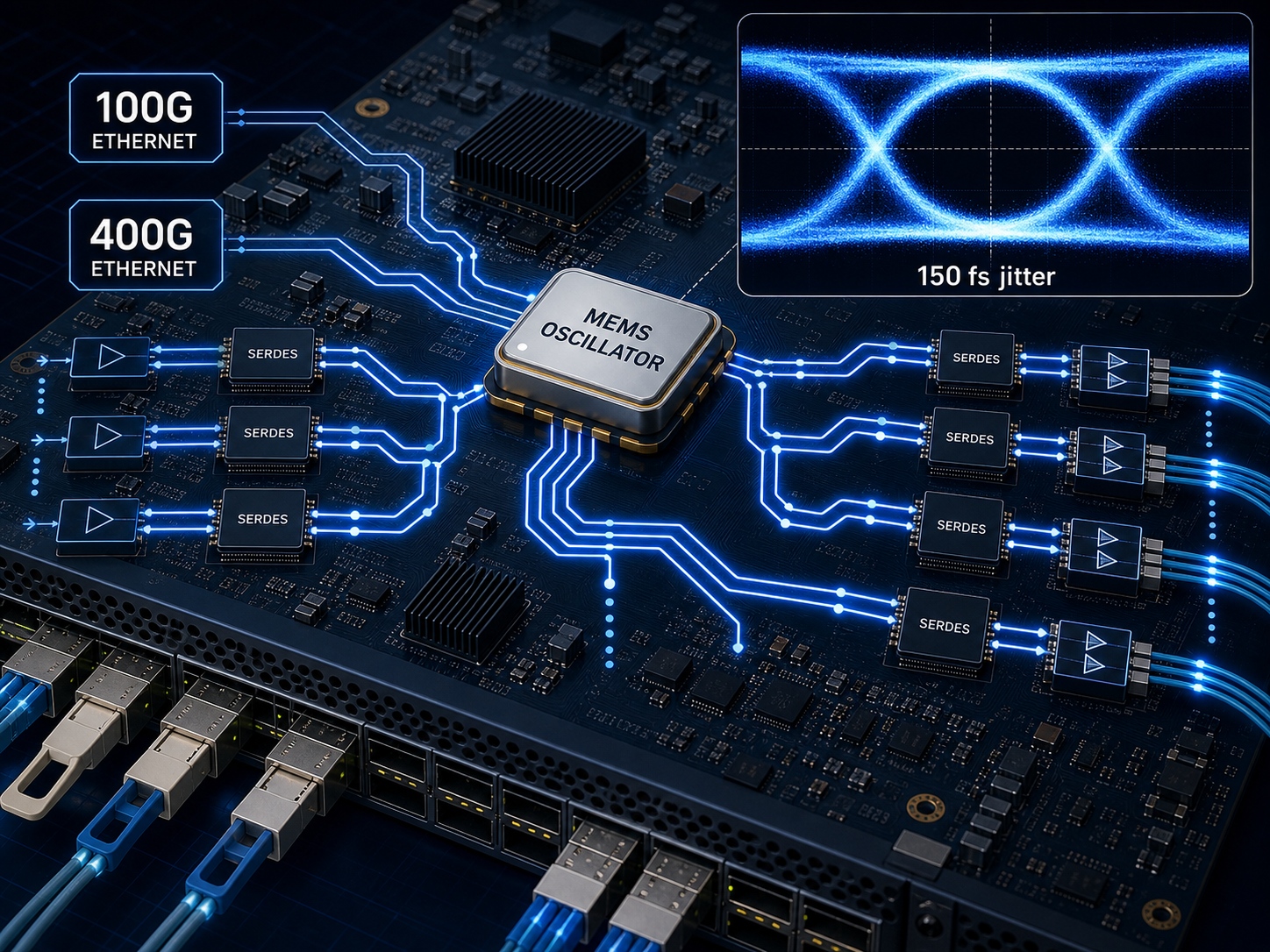
Figure 2: SiT9375 in high-speed serial link clock tree architecture — wide-open eye diagram at 150 fs RMS jitter for 100G/400G Ethernet applications.
Application Coverage: Where the SiT9375 Delivers Maximum Impact
Networking & Communications Equipment: In high-port-count routers, switches, and line cards, the SiT9375's combination of 150 fs jitter and 2.0×1.6 mm package enables dense clock distributions that were previously unachievable. The small footprint directly supports the industry's migration toward half-width and compact modular form factors in telecom and data center infrastructure.
100G/400G/800G High-Speed Data Links: For PAM4-based SerDes interfaces driving next-generation Ethernet speeds, the SiT9375 provides the sub-200 fs reference clock required to maintain adequate eye opening at 56 Gbps and 112 Gbps per-lane data rates. The FlexSwing™ output option further streamlines the interface between the reference clock and SerDes PLL inputs.
FPGA & DDR4/DDR5 Memory Subsystems: As FPGA transceivers operate at ever-higher line rates and DDR memory interfaces push past 6400 MT/s, the reference clock's frequency stability and jitter performance become yield-critical parameters. The SiT9375's ±20 ppm stability and 150 fs jitter ensure timing closure in high-performance compute, AI inference accelerator, and network processing unit (NPU) designs.
Industrial Control & Automotive Electronics: The -40°C to +105°C operating temperature range, combined with 20× vibration immunity and MEMS-level shock tolerance, makes the SiT9375 a ruggedized timing solution for factory automation controllers, autonomous mobile robots (AMRs), vehicle-to-everything (V2X) communication modules, and in-vehicle networking gateways where environmental resilience is non-negotiable.
The Clock Foundation for Next-Generation Infrastructure
The SiT9375 differential MEMS oscillator addresses the two defining architectural challenges in modern communications hardware — ultra-low timing jitter and extreme PCB miniaturization — with a single, unified solution. It is not merely a high-performance clock component; it is a critical enabling technology for the infrastructure that will carry 6G wireless, AI-scale compute interconnect, and terabit-class optical networking into deployment.
As the industry trajectory accelerates toward higher data rates, denser system integration, and harsher operating environments, MEMS-based timing technology — represented at its performance apex by the SiT9375 — is positioned to progressively displace legacy quartz oscillators across an expanding range of applications. For system architects evaluating next-generation clock trees, the SiT9375 offers a compelling value proposition: lower jitter, smaller size, superior reliability, and faster time-to-market — all within a single oscillator footprint.
Evaluate SiT9375 for Your Next Design
●150 fs RMS Ultra-Low Jitter
●2.0×1.6 mm Industry-Smallest Package
●Free Samples & FAE Support
●34 Frequencies In Stock
SiT9375: 150 fs RMS Ultra-Low Jitter Differential MEMS Oscillator with Industry's Smallest 2.0×1.6 mm Package
Time: 2026-07-31 15:56:59
Breaking the High-Speed Clock Barrier: SiT9375 Redefines Industry Standards with 150 fs Jitter and the Industry's Smallest Differential Package
As 5G communications, hyperscale data centers, and AI/ML compute clusters continue their exponential growth trajectory, modern electronic systems are navigating an unprecedented data deluge. In high-speed data links — from 100G to 400G Ethernet and beyond to emerging 800G standards — the system clock serves as the heartbeat of the entire signal chain. Clock signal integrity directly governs bit error rate (BER), eye diagram margin, and overall system stability. However, the communications industry now faces a compounding dual challenge: relentless pressure to reduce timing jitter below sub-200-femtosecond thresholds while simultaneously shrinking PCB footprints in increasingly dense hardware deployments.
Traditional quartz-based differential oscillators — constrained by fundamental mechanical resonator physics — are approaching their performance ceiling in both jitter floor and minimum package geometry. The industry has been waiting for a technology platform that can break through both barriers simultaneously. SiTime's SiT9375 differential MEMS oscillator delivers precisely that breakthrough, combining 150 fs RMS typical phase jitter with 2.0×1.6 mm package dimensions — the smallest differential oscillator footprint available on the market today.
Figure 1: SiTime SiT9375 — 150 fs RMS ultra-low jitter differential MEMS oscillator in 2.0×1.6 mm QFN package.
SiT9375 Product Overview: Purpose-Built for the Communications Era
The SiT9375 is a high-performance differential MEMS oscillator engineered by SiTime to address the most demanding requirements of modern communications infrastructure. Spanning 34 standard frequencies from 25 MHz to 644.53125 MHz, the SiT9375 eliminates the mechanical resonator limitations inherent in quartz crystal oscillators, delivering MEMS-based reliability with quartz-beating phase noise performance. Whether deployed as a reference clock for high-speed network routers and switches, SerDes transceivers, or as a precision clock source for FPGA and DDR4/DDR5 memory subsystems, the SiT9375 delivers best-in-class jitter performance without compromising on board space.
SiT9375 Technical Specifications At a Glance
The SiT9375 achieves industry-leading performance across every critical parameter for high-speed clocking applications:
| Parameter | Specification |
|---|---|
| Oscillator Type | Differential MEMS Oscillator (XO-DE) |
| Frequency Range | 25 MHz ~ 644.53125 MHz (34 standard frequencies) |
| Phase Jitter | 150 fs RMS (typical, 12 kHz ~ 20 MHz integration bandwidth) |
| Frequency Stability | ±20 ppm, ±25 ppm, ±30 ppm, ±50 ppm |
| Output Types | LVPECL, LVDS, HCSL, Low-Power HCSL, FlexSwing™ |
| Operating Temperature | -40°C to +105°C |
| Supply Voltage | 1.8V, 2.5V, 3.3V, 1.71–3.63V, 2.25–3.63V |
| Package Dimensions | 2.0×1.6 mm, 2.5×2.0 mm, 3.2×2.5 mm |
| PSNR (Power Supply Noise Rejection) | 9 fs/mV (typical) |
| Vibration Sensitivity | 20× better than quartz crystal oscillators |
Six Technology Differentiators That Set the SiT9375 Apart
The SiT9375's market leadership position is built on architectural and process innovations that address the root causes of timing degradation in real-world system environments:
1. 150 fs RMS Ultra-Low Jitter for Maximum Signal Integrity. In high-speed serial links, every femtosecond of timing jitter translates directly into eye diagram closure and increased BER. The SiT9375's 150 fs RMS typical phase jitter (12 kHz to 20 MHz) provides substantially wider timing margins than conventional solutions, enabling robust low-jitter operation in 100G/400G Ethernet physical layers, PAM4 signaling chains, and high-speed backplane architectures.
2. Industry's Smallest Differential Package — 2.0×1.6 mm. Until the SiT9375, differential oscillators were constrained by the physical size of quartz crystal blanks, which cannot be reliably fabricated below certain mechanical dimensions. SiTime's MEMS technology bypasses this limitation entirely. The 2.0×1.6 mm package represents a 60–80% PCB area reduction compared to legacy quartz differential oscillators, freeing precious board real estate in space-constrained optical modules, small-form-factor pluggable (SFP/QSFP) transceivers, and high-density switch ASIC layouts.
3. FlexSwing™ Driver — Simplifying Multi-Standard Interface Design. The proprietary FlexSwing™ output technology delivers LVPECL-comparable signal integrity while allowing independent control of VOH and VOL output levels. This eliminates the need for external AC-coupling capacitors, termination resistor networks, and level-translation circuitry when interfacing with non-standard chipset input voltage requirements. The result: reduced BOM cost, fewer PCB passives, and simplified signal integrity validation across multi-vendor component ecosystems.
4. Industry-Best Power Supply Noise Rejection (PSNR) of 9 fs/mV. In real-world system environments, switching regulators, DC-DC converters, and high-current FPGA/ASIC cores inject substantial noise into power distribution networks (PDNs). The SiT9375's 9 fs/mV typical PSNR — translating to 0.009 ps per millivolt of supply ripple — provides best-in-class immunity to PDN noise. Even in electrically noisy environments with sub-optimal power supply filtering, the SiT9375 maintains stable, low-jitter clock output without requiring dedicated ultra-low-noise LDO regulators.
5. 20× Better Vibration Immunity — MEMS Resilience for Harsh Environments. Unlike quartz crystal resonators, whose piezoelectric elements mechanically couple to external vibration and shock, the SiT9375's MEMS resonator structure is inherently immune to acceleration-induced frequency perturbations. With 20× better vibration sensitivity than quartz equivalents, the SiT9375 minimizes packet loss and timing errors in vibration-rich deployment environments including automotive ADAS platforms, industrial robotics, cellular base stations, and aerospace avionics.
6. Flexible Voltage Options and Programmable Frequency. Supporting supply voltages as low as 1.8V with options spanning 2.5V, 3.3V, and wide-range continuous voltage inputs, the SiT9375 offers system designers additional power-saving headroom. Factory-programmable frequency customization eliminates the multi-week lead times associated with custom quartz oscillator orders, giving engineering teams the agility to iterate on clock tree designs without schedule risk.
Figure 2: SiT9375 in high-speed serial link clock tree architecture — wide-open eye diagram at 150 fs RMS jitter for 100G/400G Ethernet applications.
Application Coverage: Where the SiT9375 Delivers Maximum Impact
Networking & Communications Equipment: In high-port-count routers, switches, and line cards, the SiT9375's combination of 150 fs jitter and 2.0×1.6 mm package enables dense clock distributions that were previously unachievable. The small footprint directly supports the industry's migration toward half-width and compact modular form factors in telecom and data center infrastructure.
100G/400G/800G High-Speed Data Links: For PAM4-based SerDes interfaces driving next-generation Ethernet speeds, the SiT9375 provides the sub-200 fs reference clock required to maintain adequate eye opening at 56 Gbps and 112 Gbps per-lane data rates. The FlexSwing™ output option further streamlines the interface between the reference clock and SerDes PLL inputs.
FPGA & DDR4/DDR5 Memory Subsystems: As FPGA transceivers operate at ever-higher line rates and DDR memory interfaces push past 6400 MT/s, the reference clock's frequency stability and jitter performance become yield-critical parameters. The SiT9375's ±20 ppm stability and 150 fs jitter ensure timing closure in high-performance compute, AI inference accelerator, and network processing unit (NPU) designs.
Industrial Control & Automotive Electronics: The -40°C to +105°C operating temperature range, combined with 20× vibration immunity and MEMS-level shock tolerance, makes the SiT9375 a ruggedized timing solution for factory automation controllers, autonomous mobile robots (AMRs), vehicle-to-everything (V2X) communication modules, and in-vehicle networking gateways where environmental resilience is non-negotiable.
The Clock Foundation for Next-Generation Infrastructure
The SiT9375 differential MEMS oscillator addresses the two defining architectural challenges in modern communications hardware — ultra-low timing jitter and extreme PCB miniaturization — with a single, unified solution. It is not merely a high-performance clock component; it is a critical enabling technology for the infrastructure that will carry 6G wireless, AI-scale compute interconnect, and terabit-class optical networking into deployment.
As the industry trajectory accelerates toward higher data rates, denser system integration, and harsher operating environments, MEMS-based timing technology — represented at its performance apex by the SiT9375 — is positioned to progressively displace legacy quartz oscillators across an expanding range of applications. For system architects evaluating next-generation clock trees, the SiT9375 offers a compelling value proposition: lower jitter, smaller size, superior reliability, and faster time-to-market — all within a single oscillator footprint.
Evaluate SiT9375 for Your Next Design
●150 fs RMS Ultra-Low Jitter
●2.0×1.6 mm Industry-Smallest Package
●Free Samples & FAE Support
●34 Frequencies In Stock
Other Articles
-

Role of 32.768 kHz in Circuit Design
-
SiTime Automotive Oscillators
-
The Role of 32.768kHz in Circuits
-
Epson RTC modules solve three major pain points of ioT
-
11.0592MHz Crystal Oscillator: The "Heart" of the Computer Motherboard?
-
Examine the cost and design considerations of crystals and oscillators
-
Exploring how YXC oscillators show their skills to help with AI servers
-
Lessons from the Middle East Events — The Importance of Localization!
-
Good News: YQM won Epson's 2023 New Market Development Award !!!
-
YXC Active Differential Programmable Crystal Oscillator Supports 5G Base Station Applications


Copyright By © YQM ELECTRONICS INTL LIMITED SITEMAP
Email: sales@yqmec.com

点击右上角
分享给朋友吧


